Showing posts with label Flowers. Show all posts

Friday, June 28, 2019

Small White Rose and Red Rose as well as other Flowers

I saw small white rose and red rose today at the side of the street near the main cross-road of the old downtown of Manokwari. The rose plants, together with other flower plants were grown as hedgerow in the frontyard of a house. Across from the roses plants, on the other side of the street was the compound of army MP. 
White Rose

Thursday, June 27, 2019

Flowers in My Neighborhood

I made pictures of some beautiful flowers today. I have just returned from my afternoon walking exercise around my neighborhood. I walked to a football field around 500 meters (1,640 feet) from my house. A long the way to the field, I saw some tropical flowers. There were Yellow Beach Hibiscus, White and Red Bougainvillea in the frontyard of Saint Agustinus church. 
Yellow beach hibiscus
Yellow-beach Hibiscus
When entered the military compound next to the church, I saw some flower plants along the road-side too. Very beautiful white plumeria stood by the wall fence. There were also jasmine flowers on the other side of the road. They were planted by families of the military officers who live in the compound. In Bali the plumeria is called Frangipani but here in West Papua, we call it Kamboja.
Bunga Kamboja or Frangipani
White Plumeria
Crepe Ginger Flower (Cheilocostus speciosus)
Near the corner of the road that turns to right, I saw another white flower that usually grows in the forest edges. Its English name is Crepe Ginger Flower (Cheilocostus speciosus). I approached it and took one photograph of the flower. I did not bring my pocket camera Fujifilm XQ2. I only used the camera feature of my Samsung Tab A. In wikipedia, it says that this plant has got a lot of medicinal functions such as for fever, rash, asthma, an intestinal worms. 
As a walked up the slopes to the football field, I saw some pink orchid flowers at the front yard of a house. I stopped for a while to take pictures of the orchids. They look like Cattleya Orchids.
Pink orchid flowers
Orchid
The weather today was nice. It was not very hot. So, I enjoyed my walking exercises around the track of the football field. There were tens of people in the field. Some were playing football whereas others were just jogging or walking. Most of them were young men and women. 
Rainfall in this city is decreasing in its frequency starting from June. I hope to see more flowers where ever I travel. written by Leo Charles Roring
Also read:

Birdwing Butterfly and Red Hibiscus Flower

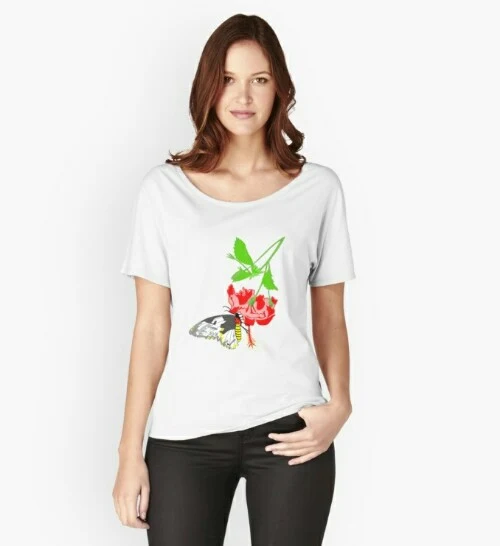
Please, support this blog by clicking and purchasing the following artdrawing of mine below that is printed on various products in Redbubble website: This birdwing butterfly Ornithoptera priamus lives in the jungle of New Guinea - the largest tropical island in the world. I saw this butterfly when I was guiding a British tourist on a rainforest tour in the northern coast of West Papua. 
https://www.redbubble.com/shop/ap/20916614?asc=u

Birdwing butterfly and red hibiscus flower
Butterfly and Red Hibiscus

Related Post: Flower Tour in Minahasa Highland

Saturday, June 15, 2019

Coral Reef - the Flowers of the Sea

I spend much of my time in Sorong and Raja Ampat now. I usually go snorkeling and freediving at Warduwer beach. It is located in southern region of Waigeo island. The coral reef of Warduwer beach is very beautiful. It is colorful and looks like underwater flowers. There are a lot of fish that live in them including anemonefish, butterflyfish, moorish idol, damselfish, parrotfish, wrasse, coris, and a lot more. 
Christmas Tree Worms
Christmas Tree Worm in Raja Ampat
Christmas Tree Worms are some of the many marine creatures that are similar to flowers. They have got vivid colors such as blue, orange, yellow, red and purple. They live by catching or filtering tiny food objects or microorganism. Because of this filtering function, Christmas Tree Worms play important roles in making the sea clean. There are also sea anemone whose forms are similar to flowers. They become the "nests" for fish like Orange Skunk Anemonefish, Red and Black Anemonefish as well as Spinecheeck Anemonefish. Sea Anemone maybe harmful for other fish but not for the clownfish.
Coral Reef Environment in Warduwer Beach
 There are also burrowing clams that build their houses by sinking their shells into the surface of big rocks in a very slow rate. They filter food from the sea.
Coral reef has got functions that is similar to rainforest. It is the natural habitat of a lot of marine creatures. Therefore, they have to be preserved.
Burrowing Clams
Burrowing Clams
In addition to burrowing clams, christmas tree worm, table coral, cauliflower corals, there is also Pulsating Xenid (Heteroxenia fuscescens) that visitors can see in the waters of Warduwer beach of Waigeo island. It is a species of soft coral that lives in shallow water. It has got tentacles with polyps whose appearance are similar to small flowers. The movements of tentacles in the waters are influenced by waves and sea current. Its polyps open and close in a pumping or pulsating movement to filter food or nutrients from the sea.
Pulsating Xenid
Booking
If you are interested in taking a snorkeling holiday in Raja Ampat and want me to organize your trip, please, contact me by whatsapp to: +6281332245180 or by email to: peace4wp@gmail.com

Friday, December 30, 2016

Wild Flowers in Arfak Mountains of Manokwari

Passion flower
Passion flower near Lake Anggi Giji
I made several trips to Arfak mountains recently where I guided some tourists from Australia, Indonesia, Austria and China. We visited the jungle of Mount Soyti, Mount Sensenemes, Mount Kobrey and Mount Mabowi. During the trips I saw a lot of beautiful flowers including Rhododendron konori, Rhododendron laetum, Myrmecophyte, orchid, nepenthes and a lot more.
White orchid
Orchids in the jungle of Mount Soyti
The areas around Lake Anggi Giji and Lake Anggi Gida were full of wild flowers that grew on the elevation between 2,000 and 2,730 meters above sea level. We couldeasily find them in the slopes, on the road sides, and on top of the mountains. The indigenous people who live in the villages around the lake grow the flowers in the frontyards of their houses. There are a lot of flowers which I haven't been able to identify.
Visitors who joined my Arfak mountains tour were very to see the flowers and the beautiful scenery taken from the slopes and tops of the mountains above Anggi lakes.
Rhododendron konori
Rhododendron konori
on top of Mount Sensenemes
After visiting Anggi lakes, we went down the steep slopes of Arfak and continued our trip to the jungle of Warmarway. There, we walked up very steep slopes to a basecamp and stayed for several days. This time the vocal points of the tour were not flowers but Birds of Paradise, Glowing Mushroom, and Butterflies.
Our basecamp was constructed near a stream whose water. We boiled its crystal clear water for our drinking water. We also took a bath in the stream. Early in the morning when it was still dark, we woke up at 04.30 to drink some tea or coffee. After that we left our tents for the lek of Lesser Birds of Paradise. It was a nice adventure because we could watch how male lesser birds of paradise performed their courtship dance to seduce or attract their female birds.
traditional village in Arfak mountains
Traditional house of Sougb tribe
At the end of our trip in the jungle, we visited Warmarway village where we saw our local guide Yunus made fire using traditional matches. This Papuan matches were made of a piece of bamboo and palm fiber. It had been used by the indigenous Papuan people in the vogelkop region of West Papua before modern matches were introduced by the Dutch.

Tour Around Arfak Mountains
Anggi lake of West Papua
Lake Anggi Gida
I offer tour package around Arfak mountains where visitors will be able to explore the tropical rainforest, see beautiful scenery around Anggi lakes and interact with the indigenous people.

Wildlife
It is not only flowers that visitors will be able to see during the tour but also wild animals such as birds of paradise, vogelkop bower bird, western parotia, cuscus possum, butterflies and etc.

Meeting and Staying with the Indigenous People
During the trip, participants will meet indigenous people of Arfak mountains from several different tribes. We will even stay in their traditional house.

Interested?
I suggest the number of participants of the tour is 2 to 3 people to share the cost. If you are interested, please, contact me by e-mail to: peace4wp@gmail.com or whatsapp: +6281332245180 for the price and customized itinerary.

Also read:

Wednesday, October 26, 2016

Rainforest Flowers in Klasow Valley of Sorong Regency

I often see wild flowers in the rainforest of Klasow valley when I guide tourists on hiking and birdwatching tours in West Papua. There are tens of villages in the valley including Malagufuk, Klatomok, Klayeli, Malagubtuk, Klabili, Klasow, and etc. The valley is located in the east of Sorong city around 1.5 hours by 4WD car and then another 1.5 hours on foot through the jungle to reach a small village near Klabolo stream. Tropical plants such as iron wood tree, pandanus, ficus tree, lianas, and various shrub plants grow along the paths that lead visitors to the jungle village. Everything looks green in the jungle. However, if we do careful exploration of the forest, we will be able to see various species of flowers that can only be seen in tropical rainforest.
Big Flowers from the Jungle
Rainforest Red Flower Uvaria papua
Early this month I saw a big flower whose petals were red. Its stigma was yellow. I never saw it before so I uploaded on my Facebook account and ask my friends to help me. Some people said that it was Uvaria grandiflora but based on my obsevation, the leaves are different and this flower does not have white color at the base of its petals that surrounds the stigma.  After reading their comments and suggestions, I decided to name: Uvaria papua.

Zinnia Flower and Blue Tiger Butterfly
There are a lot of other flowers that we can see in the forest of Klasow valley. The main problem that I face is the lack of field guide books for Flowers of New Guinea. So, I could only upload them in this blog and hope that readers will help me identify them.

Birdwatching
There are a lot of birds that we can see in the valley. As a matter of fact, I have organized birding trips to this forest numerous times. Some of the birds that I and the birdwatchers saw or heard during the trips are listed below:
Western-crowned Pigeon (Goura cristata)
Western Crowned Pigeon in
the jungle of Klasow valley
  • Lesser Birds of Paradise (Paradisaea minor)
  • Magnificent Riflebird (Ptiloris magnificus)
  • Twelve-wired Bird of Paradise (Seleucidis melanoleuca)
  • King Bird of Paradise (Cicinnurus regius)
  • Lowland Peltops (Peltop blainvilii)
  • Shining Flycatcher (Myiagra alecto)
  • Frilled Monarch (Arses telescophthalmus)
  • Helmetted Friarbird (Philemon buceroides)
  • White-bellied Cuckoo-shrike (Coracina papuensis)
  • Glossy Swiftlet (Collocalia esculenta)
  • Moustached Tree-swift (Hemiprocne mustacea)
  • Papuan Frogmouth (Podargus papuensis)
  • Dollarbird (Eurystomus orientalis)
  • Papuan hornbill (Rhyticeros plicatus)
  • Rufous-bellied Kookabara (Dacelo gaudichaud)
  • Shovel-billed Kingfisher (Clytoceyx rex)
  • Forest Kingfisher (Halcyon macleayii)
  • Dwarf Kingfisher (Ceyx lepidus)
  • Yellow-billed Kingfisher (Halcyon torotoro)
  • Black Lory (Chalcopsitta atra)
  • Eclectus parrot (Eclectus rotatus)
  • Sulphur Crested Cockatoo (Cacatua galerita)
  • Red-cheeked Parrot (Geoffroyus geoffroyi)
  • Western Black-capped Lory (Lorius lory)
  • Large Fig Parrot (Psittaculirostris desmarestii)
  • Pinon Imperial Pigeon (Ducula pinon)
  • Pink-spotted Fruit Dove (Ptilinopus perlatus)
  • Wompoo Fruit-Dove (Ptilinopus magnificus)
  • Beautiful Fruit-Dove (Ptilinopus pulchellus)
  • Western Crowned Pigeon (Goura cristata)
  • Brahminy Kite (Haliastur indus)
  • Grey-headed Goshawk (Accipiter poliocephalus)
  • Dwarf Cassowary (Casuarius bennetti)
  • Hooded Pitta (Pitta sordida)
  • and etc.

Rainforest Tour
Interested in visiting rainforest in Klasow valley to see flowers and butterfly? Please, contact me by email to: peace4wp@gmail.com or use the contact form in the top right side of this blog.

Saturday, March 12, 2016

Rainforest Flower and Butterfly Watching in Sorong of West Papua

When I guide tourists on a rainforest tour in Klasow valley of Sorong regency in West Papua, I often see flowers that are unique and beautiful. Everything looks green in the forest but a white or pink flower will attract the attention of visitors. Fresh flowers that bloom in the morning attrack butterfly. That's why when we see flowers in the jungle village of Klasow valley, we will also be able to see butterflies.

Butterfly-watching
Local people in Klasow valley plant a lot of zinnia and some hibiscus flowers in their jungle village. These flowers attract various species of butterfly such as Blue Mountain Swallowtail (Papilio ulysses), Meadow Argus Butterfly (Jinonia villida), Cruiser Butterfly (Vindula arsinoe), Blue Tiger Butterfly (Tirumala limniace), Taenaris Catops Butterfly and a lot more.

These beautiful butterfly collect nectar from the flowers and also help the pollination of most of the flower plants in the rainforest.
Birdwatching
In addition to observing flowers, and butterfly, visitors who take the rainforest tour in Sorong regency of West Papua are able to watch birds. Klasow valley has been the natural habitat of Golden Myna (Mino anais), Pink-spotted Fruit Dove, Blyth's hornbill (Rhyticeros plicatus), Large Fig Parrot, and Pinon Imperial Pigeon, Western Crowned Pigeon and a lot more.

Itinerary for Rainforest Tour
Day 1
Transfer from Sorong city to Klasow valley by 4WD car (1.5 hours ride),
Walking through the forest to reach a jungle village (approx. 1.5 hours walk)
Birding around the village
Butterfly Watching

Day 2
Wake up early in the morning at around 04.30
Walk to the display tree of Lesser Birds of Paradise
Watching the paradise birds until 09.00
Walk back to the village
Jungle walk to see rainforest flowers and butterflies as well as birds 
Night walk

Day 3 
Jungle walk to Klaglass
Back to the village

Day 4
Watching Sulphur Crested Cockatoo
After lunch, we will walk back to the main road
Return to Sorong by a 4WD car.


Sightseeing and Snorkeling Tour in Raja Ampat
Besides guiding tourists in the jungle of Sorong regency and Tambrauw regency, I also offer a 5-day/ 4-night snorkeling and sightseeing tour in Raja Ampat islands. Participants of the tour will be transferred from Sorong city to one of the homestay in the archipelago and travel around the islands by motorized boat to see spectacular scenery of Raja Ampat as well as its pristine coral reef and ornamental fish.

Coral Reef in Raja Ampat islands
ITINERARY for Raja Ampat
Here is a typical itinerary that I offer to my customers:
Day 1
Leaving Sorong for Raja Ampat
We will stay at one of the homestays in the regionSnorkeling in Yenbuba strait

Day 2
Traveling to Kabui karst islets (snorkeling) and  a visit to its passage.
Snorkeling in Batu Lima or Friwen
A visit to sand bank

Day 3
Traveling to Pianemo to see its beautiful scenery on top of one of its karst islets
Snorkeling in Arborek

Day 4
Snorkeling in North West Mansuar
Snorkeling in South West Mansuar or Sawondarek

Day 5
Leaving Raja Ampat for Sorong
The above itinerary should be seen only as a reference. The places or snorkeling sites can be changed during tour depending on weather condition, tide.
Pianemo Karst Islets in Raja Ampat Archipelago

If you are interested in taking a rainforest tour in Klasow valley of Sorong regency or snorkeling and sightseeing tour in Raja Ampat, please, contact me (Charles Roring) by e-mail to: peace4wp@gmail.com. You could also use the contact form at the top right area of this blog.
Also read:

Discover the Avian Wonders of Minahasa Highland: Birding Around Sonder Town
Are you an avid birdwatcher searching for a tropical birding destination teeming with exotic avifauna, including many endemics? Look no further than Sonder in the Minahasa Highlands of North Sulawesi, Indonesia. This charming subdistrict town, nestled amidst lush forests, farmlands, and rice paddies, offers a unique and accessible birding experience unlike the more crowded reserves. The average duration of birding tour in Sonder is 3 days/ 2 nights. 
Sulawesi Cuckoo-dove (Macropygia doreya albicapilla)
Sulawesi Cuckoo-dove
🌿 Why Sonder is a Recommended Birding Destination
Sonder sits in a transitional zone, blending lower montane forest species with lowland and rice field birds, creating a high diversity in a relatively compact area. The easy access and varied landscape—from small, accessible forests to open agricultural fields—make it ideal for birders of all fitness levels.
Sulawesi Scops Owl (Otus manadensis) - nocturnal bird of Manado
Sulawesi Scops Owl
🌟 Sonder's Must-See Bird Species
While Sulawesi is famous for its high number of endemic birds, Sonder provides a fantastic chance to tick off several key species. Keep your binoculars ready for these highlights:
Some of Endemic Birds of Sulawesi :
  • Sulawesi Hanging Parrot (Loriculus stigmatus): A beautiful, tiny parrot often seen feeding on blossoms.
  • Yellow-billed Malkoha (Rhamphococcyx calyorhynchus): A large, striking cuckoo endemic to Sulawesi.
  • Pale Blue Monarch (Hypothymis puella): An exquisite, azure-colored flycatcher.
  • Sulawesi Scops Owl (Otus manadensis): Often a target for nocturnal birding around the town's outskirts.
  • Sulawesi Myzomela
  • Sulawesi Blue Flycatcher
  • Gray-sided Flowerpecker
  • Crimson-crowned Flowerpecker
  • Pale Blue Monarch
  • Sulawesi Pygmy Woodpecker and a lot more.
Pale Blue Monarch (Hypothimis puella) - endemic bird of Sulawesi
Pale Blue Monarch
Highland & Forest Dwellers: 
  • Grey-cheeked Green Pigeon (Treron griseicauda): A subtly beautiful pigeon.
  • Yellow-sided Flowerpecker (Dicaeum aureolimbatum): A small, energetic passerine, an endemic species of Sulawesi island.
  • Crimson Sunbird (Aethopyga siparaja): Dazzlingly coloured, frequently seen sipping nectar.
Farmland & Open Area Birds:
  • White-browed Crake: Often sighted around the paddy fields.
  • Barred Rail (Gallirallus torquatus): A skulking rail that pops out in the wet fields.
  • Black-naped Oriole (Oriolus chinensis): Known for its melodious call.
🗺️ Best Birding Spots in Sonder
Sonder's magic lies in its accessibility, with excellent birding spots often just a short walk or drive away.
Tounelet Forest Slope: Located right in the town of Sonder, this small forest patch offers easy roadside birding and is a prime location for the Pale Blue Monarch and various flowerpeckers.
Farmlands and Rice Paddies: The agricultural areas, especially towards villages like Tincep, are fantastic for waterbirds such as the White-browed Crake, Cattle Egret, and Purple Heron, as well as common passerines and raptors like the Black Kite.
Higher Elevation Farmland and Forest: Exploring the outskirts and higher elevations offers a chance to see montane species like the Sulawesi Blue Flycatcher and different kinds of white-eyes.

📅 Optimal Time for Birding
Best Time of Year: Birding in Sonder is excellent year-round, but avoiding the heaviest rainy months (typically December to February) can make walking more comfortable.
Best Time of Day: As with most tropical birding, the early morning (05:30 to 09:30) is the most active period. A second session in the late afternoon (15:00 to 18:00) is also highly productive, particularly for owls at dusk.

🧳 Planning Your Sonder Birding Trip
Sonder is easily reachable from Manado, the capital of North Sulawesi.
  • Getting There: Fly into Sam Ratulangi International Airport (MDC) in Manado city. Sonder is about a 1-hour drive by car.
  • Accommodation: While some birders base themselves in nearby Tomohon, staying in or near Sonder allows you to maximize the valuable early morning hours. Look for local homestays or dedicated birding accommodations in the area.
  • Gear Essentials: Bring a good pair of binoculars, a telephoto camera lens for photography, and a reliable local field guide (e.g., Birds of the Indonesian Archipelago or install Merlin app into your cell phone).The terrain is generally easy, but comfortable walking shoes are recommended.
Sonder offers a relaxing yet rewarding birding experience. It's a place where unique Sulawesi endemics can be found right alongside common, colourful tropical species, making every walk a potential treasure hunt.

Ready to plan your birding adventure to the Minahasa Highlands? 
Would you like more information on combining a trip to Sonder with other North Sulawesi birding hotspots like Tangkoko Nature Reserve or Mount Mahawu?
Please, contact me (Charles Roring) by email to: peace4wp@gmail.com or through whatsapp by pressing the following button:

Friday, December 7, 2012

Flowers in the Rainforest of West Papua

There are a lot of flowers that we can see while hiking in the jungle of Manokwari. Some have fragrant smell whereas others release stink smell. One species that attracts my attention is the Faradaya splendida. This plant grows on the bank of Dopi river. It has got abundant flowers whose color is white. Anybody who is interested in growing it outside his or her house must provide a lot of water for this plant. I think that the flowers from Faradaya splendida vine can be used as raw material for extracting its essential oil that is good for aroma therapy.
Glory Vine (Faradaya splendida)
Faradaya splendida
Another species that is commonly seen along the edges of the tropical rainforest is the blue bell vine (Thunbergia grandiflora). The vines of blue bell flowers hang on the branches and twigs of trees that are exposed to sunlight. Sometimes they can be found hanging on the twigs of bamboo shrubs that grow near a river.
For coastal region, the most common species that can be seen is hibiscus. They have got white, red, yellow and pink colors. There is another one that is quite unique called Barringtonia asiatica. This hairy flower will develop itself into a seed that is poisonous. Local fishermen use the seed of Barringtonia asiatica to poison fish. Before frying the fish, they will take out its gills and intestines. Barringtonia asiatica flowers come from a big tree that can be found near at the beach along the coastal region of Manokwari.
In the high elevation region such as the Arfak mountains, passion fruit flower vines climb the shrubs and trees that are not far from the local villages. This passion flower whose photograph is shown below is not a native plant from this mountain. Its fruit has got sweet taste. I heard that it was introduced by missionary and local people who went to Wamena (in the Central Mountains of West Papua) and returned to Arfak mountains with the plant.
Below is the picture of Medinilla flowers. I saw these flowers while hiking in the jungle of Arfak mountains particularly on 1400 meters above sea level. The flower species found around this elevation are totally different from the species that usually grow in lowland or coastal region of West Papua.
In addition to Medinilla, some other flowers that attract the attention of visitors are the Rhododendrons.  A few months ago, a student from the United Kingdom visited Arfak mountains to see several species of Rhododendrons. The one that is shown below has got very fragrant smell. Its physical appearance is similar to the above Faradaya splendida. This rhododendron can be found at the top of Mount Syoti (which is part of Arfak mountains and located in Kwau village).
In addition to the above flowers, visitors can also see various kinds of orchid that grow on the branches of big trees of the tropical rainforest of Manokwari. Some of them have got medicinal merit and are used by the indigenous people to cure their diseases or wounds. by Charles Roring
Also read:

Sunday, May 13, 2012

Rainforest Flower Ipomoea Aquatica

The following flower in Latin is called Ipomoea Aquatica. This is a famous aquatic plant in the tropical regions. In Indonesia this plant is known as "kangkung." People eat both the stem and the leaves of kangkung as delicious vegetables. The kangkung vegetables can be served in raw or stir-fried with salt, onion and dried shrimp paste added to the dish. Although Ipomoea Aquatica has got beautiful flowers, they are not used in indoor decoration. In tropical rainforest, this plant grows in swamps or in the river with slow moving stream.
This rainforest flower has got several English names. Some of them are water spinach, water morning glory and water convolvulus. The stems of Ipomoea Aquatica are hollow enabling the plant to float on the water. I took the picture of these white flowers of the water spinach next to my parent's house in Amban area of Manokwari. 

Last week I was able to identify another white flower which I saw growing in Inggramui forest. Its name is Glory Vine (Faradaya Splendida). This vine flower releases very nice fragrant.
The biodiversity in the tropical rainforest of Manokwari is very high. That's why the rainforest is seen as a recommended hiking destination for tourists who want to see the beauty of nature of New Guinea. If you are interested in hiking in Manokwari, please, contact me via email: charlesroring@gmail.com
 Also read: Rainforest Flowers in Inggramui

Saturday, November 5, 2011

Pretty Rainforest Flowers

Here are some pretty flowers that I found in the rainforest while hiking with tourists. Unfortunately, I don't know their English and Latin names. If you know, please e-mail me. As a matter of fact, the main attraction that I offer to tourists who travel with me around the tropical rainforest in West Papua is not flower watching but bird and wildlife watching. There are a lot of birds and wild animals that are endemic to New Guinea that tourists like to see. Most often, when the tourists see beautiful flowers in the jungle, they will stop for a while to take some close up pictures using the macro setting of their cameras.
I shot the following rainforest flowers using Nikon Coolpix P500. The tropical rainforest in West Papua is rich of colorful flowers including orchids.
Saturday 12 May 2012 Update
Today I am able to identify the above flowers. After searching in Google for a few hours on the internet using such keywords as rainforest tree flowers, or tree flower from tropical rainforest, finally, I got several web-pages that provide its name. In Latin, it is called Spathodea campanulata whereas in English, it is called Fountain Tree, African Tulip Tree and Flame of the Forest. This flower tree can easily be seen when we go hiking in the low elevation forest around Manokwari. The height of this tree can reach up to 25 meters. I still have to find the names of the flowers below. 

Most of the flowers that I shot were not far from me but the pink ones on the third picture above were  hanging on a vine some 5 meters above my head on a slope under a big tree. I had to walk through shrubs, and thorny vines to shoot them. After nearly 15 minutes shooting those trumpet like flowers, I finally was able to shoot them using the super zoom feature of my Nikon P500 camera. The result was a little bit blurred because I was shooting them in low light condition. Nikon has improved the capability of its point and shoot camera by increasing the super telephoto capability to 42 x in its newest product the Nikon Coolpix P510. This bridge camera is suitable for anybody who is interested in taking pictures of distant subjects. I recommend the Nikon Coolpix P510 to you if you need compact superzoom camera. With its 42x optical zoom (equivalent to 1,000 mm in 35 mm lens format), the Nikon Coolpix P510 now is a bridge camera with the highest super zoom capability.  
If you are interested in seeing flowers in the tropical rainforest of West Papua, and need a guide to accompany you around, please, contact me via my email: peace4wp@gmail.com.
Related articles: 

Tuesday, October 4, 2011

Rainforest flowers in Inggramui village of Manokwari

Tropical rainforest in New Guinea is home for various species of flowers that have got beautiful forms and colors. For example an orange flower that I saw while hiking with 2 Dutch tourists last August 2011 in the jungle of Inggramui village. This tropical rainforest flower is unique because it looks like a flame that is burning from a torch. Unfortunately, I don't know the name of this species both in English or Latin. If you know it, please contact me.
I shot it using my pocket camera - Panasonic Lumix DMC FT3. It is an ideal photographic equipment for someone like me who likes traveling in the rainforest. Its waterproof construction is useful when I want to take pictures of subjects in environment that is wet or whose humidity is very high. Besides this orange flower, I also saw some beautiful white flowers that bloom out from hanging vines near a river. They are so beautiful and fragrant. I believe that these fragrant flowers can be cultivated for making perfume or other cosmetic products.
Post Update on 6 May 2012:
A girl from Surrey, Georgina, sent me an email last week and told me that the above flowers could be the Faradaya splendida (commonly known as the Glory Vine) or something similar to it. Because this flower plant grows near the river, I conclude that it needs plenty of water to survive. I also did type the Latin name plant which she gave me in Google to verify its name. The results showed that this flower plant looks the same as the one described as faradaya splendida. I am quite happy with the success of this identification effort. Thank you Georgie :)
In addition to orange and white flowers, I also saw purple flowers in the forest. They were much smaller than the white flowers but they were beautiful. Butterfly and bee like to come to these flowers for harvesting their nectar. These rainforest insects help the pollination process of the flowers before they produce fruits and seeds that are important for the regeneration of most of the plants in the forest. Birds will eat the fruits and drop the seeds around the forest. This is a beautiful thing that we can learn from the complex ecosystem of the tropical rainforest. Therefore, we have to preserve this precious environment. There are a lot of things that we can see and study inside a tropical rainforest.

Because this kind of flower can only grow in the tropical rainforest, taking its seeds or roots and planting them in environments that are dry and cold will not be successful. As a tourist guide in Manokwari, I provide tours to travelers who want to go hiking and camping inside tropical rainforest of West Papua. If you are interested, you can contact me via my email peace4wp@gmail.com
Also read:
Flowers from the rainforest of Arfak mountains

Sunday, July 31, 2011

Flowers from the rainforest of Arfak mountains in Manokwari regency

Flowers that are shown in the following photograph look like plumeria. I saw it at the top of Mt. Soyti. The mountain is part of the mountain range of Arfak. I was not able to identify it but later when a British girl from Kew Royal Botanic Garden visited Manokwari in her exploration of the flower plants in Arfak, she told me that these flowers are called Rhododendron. While updating this post, I did some research on the internet trying to find the name of the flowers. Finally, I found the answer. It is called Rhododendron Konori.
They emit soft pleasant scent when I moved my nose closer to them. I took the pictures of these flowers when I was climbing the Arfak mountains with some Swiss tourists last July. These rainforest flower plants grow in one of the tops of the Arfak mountains. At the top, the main vegetation are small flower plants, moss. There are various species of orchids too particularly in the elevation between 500 to 1000 meters above sea level.
Dense rainforest can be seen growing along the slopes of the mountains. Kwau village is one of the villages in District Minyambou of Manokwari regency that has become a favorite tourist destination. Besides these fragrant tropical flowers, I also saw other species .
In addition to admiring beautiful flowers, tourists who visit Manokwari regency of West Papua can enjoy various eco-tourism activities both in the coastal areas, the lowland and the highland of Arfak mountains. From snorkeling in Manokwari bay to hiking in the mountains, the coral reef and tropical rainforest of New Guinea island can give visitors a new experience about how wonderful it is to be closer to nature. As a tourist guide, I accompanied tourists from Switzerland, Poland and Finland last month. They watched the magnificent birds of paradise when they were in Arfak mountains.
If you are now planning of traveling to Indonesia, please consider West Papua province as one of your destinations. I will be happy to guide you and show you around how beautiful this western part of New Guinea island is. by Charles Roring

Also read:
Rainforest flowers blue trumpet vines
Flowers in My Neighborbood

Wednesday, June 22, 2011

Rainforest Flowers Blue Trumpet Vine in the Table Mountain of Manokwari

This vine plant flowers throughout the whole year. According to a book entitled Tropical Plants, the genus of this rainforest flower is thunbergia. The species name is Thunbergia grandiflora Roxb. Its English name is Sky Vine or Blue Trumpet Vine. We can easily see them in open areas of the rainforest that receives full sunshine. The pale blue colors of these rainforest flowers look contrast in the middle of the dark green leaves of the plants and their supporting trees. The petals of the blue trumpet vine are soft. I photographed them when I was hiking in the Table Mountain of Manokwari. City dwellers in Manokwari have not considered the vine as a commercial decorative plant. So, it's relatively easy to find them at certain empty land areas in the city or forest edges where bush plants and vines still grow.

Monday, June 20, 2011

Rainforest Flower from Passion fruit

Flower from Markisa or internationally passionfruit is very beautiful. The white petals of the flower support the purple striped filaments that surround the style. Markisa is a delicious fruit that we can eat while traveling in Arfak mountains. Its taste is a combination of sweet and a little bit sour. When it is ripe, its skin surface looks yellow. The extract of the passionfruit is used to make syrup. Because the plant is a herbaceous vine, this rainforest flower needs supporting trees or wooden frames to grow well. In addition to passionfruit flower, tourists can also see various species of other rainforest flowers that are endemic to the tropical rainforest of New Guinea island. Because flowers have close connection with insects, particularly the butterflies, tourists can enjoy butterfly watching in Arfak mountains too.
If you are interested in traveling to Manokwari regency and Arfak mountains to see wild flowers, to watch birds, or to meet local people, please contact me (Charles Roring) by email to:  peace4wp@gmail.com
Also read:
Passion Flowers
Rainforest Flowers from the Slopes of Arfak mountains

Monday, April 11, 2011

Rainforest flowers from the slope of Arfak mountains

There are a lot of species of flowers in Arfak mountains if we visit a number of villages from Mokwam to Anggi areas. However, wild flowers that grow at the road side along the slopes of the mountains receive little attention from travelers. Last March, I guided 4 tourists from Czech Republic. We went there by a rent car. It's a 4WD Toyota Hilux. In the middle of our trip to Mokwam, Dr. Jaroslav asked the driver to stop for a while to let them take pictures of the slopes and ravines of the rainforest as well as the flowers and insects along the roadside. Stopping a car at a steep slope was very dangerous. We had to put big stones behind the tires to protect the car from moving down the slope unintentionally.
if you know the species name of these flowers, please contact me: charlesroring@gmail.com

Not far from where the car stopped, I saw some flowers. One species of them is dominated by pink color. Unfortunately, I did not bring my digital camera. I walked closer to the flower plant to see its flowers. Honestly I don't know the name of this flower. So, I only name it pink flowers. I am not sure if this is an orchid. Dr. Jaroslav knew that I liked taking pictures for my blog, so, he shot some pictures of these flowers and told me that I might copy them when we had returned to Manokwari city again.
There are various species of rainforest flowers in Arfak mountains that attract the attention of many city dwellers in Manokwari. However, because the temperature in the city is hotter than the daily temperature in Arfak mountains, these flower plants will die if planted in the city.
Arfak mountains are not far from Manokwari city. I have been promoting them as a nice tourist destination in West Papua beside Raja Ampat. For birdwatchers, and trekkers, Arfak mountains with their massive tropical rainforest that are rich of bio-diversity are worth exploring. If you are interested in traveling to Arfak mountains, and need a tourist guide, please, contact me via my email peace4wp@gmail.com. I will be happy to arrange your trip and accompany you to explore the natural beauty the mountains. by Charles Roring

Thursday, February 17, 2011

Naked Lady - rainforest flowers in Manokwari of West Papua

While I was walking around the campus of Papua university, I saw some flowers. I didn't know their name at that time but Mr. Robert Power - an Australian tourist who was walking with me said that its name was naked lady. It's a beautiful flower isn't it? Inside the tropical rainforest of West Papua, if we go hiking in the morning, we can see various kinds of flowers. From the grass to the branches of big trees, flowers bloom and attract insects such as bees and butterflies to them. I don't know whether these naked lady flowers are endemic species from New Guinea or not but they really look beautiful when planted at the front yard of our homes.
There are a lot of flower plants that are used by the indigenous Papuan people as medicinal herbs.

Naked Lady flowers
At coastal lowland areas, bougenville, hibiscus and paradise birds flowers dominate the front yard of the houses in Manokwari city. But inside the rainforest, orchids are the most common species that we can see. The price of orchids from West Papua is expensive in big cities in Indonesia triggering extensive hunting by the local people who want to make money from selling flowers. I hope that through the promotion of eco-tourism, the destruction of rainforest in West Papua can be minimized.
Booking
Interested in visiting West Papua and need me as your private guide? Please, contact me (Charles Roring) by email to: peace4wp@gmail.com or send text message to my cell phone: +6281332245180

Also read: 

Friday, December 17, 2010

Tropical rainforest Orchids

orchid of arfak mountains
Orchid Flower in Arfak range
Tropical rainforests in the mountains and islands across West Papua are now becoming the attention of biologists from around the world due to their essential functions in absorbing CO2 gases and  their natural wealth of biodiversity. The rainforest of New Guinea in the coastal and mountainous regions is rich a lot of species of flowers. Many of them are orchids. They grow on the branches of big trees twenty or thirty meters above the grounds. Due to the high demand of these tropical orchid flowers in the local and national markets, the indigenous people have collected large number of orchids and sell them in cities and towns of West Papua. These orchids plants will then be shipped to big cities in Java and sold in high prices. Because hunting orchids that naturally grow in the tropical rainforest will affect the balance of the rainforest ecosystem, there are efforts from the local Papuan themselves to cultivate these plants at their homes. By planting and growing orchids and other rainforest flowers, they can get increase the number of plants which they are able to sell. 
Although orchid farming is still considered as a small home business activity. Many people still do it in front of their home yards. There are not any companies in West Papua that have opened large areas of farmland to be used for cultivating orchid flowers.
A few months ago, there was an Orchid exhibition in Manokwari city organized by the government to promote orchid as a non-timber forest or agricultural products. Papua and West Papua provinces have a number of dendrobium orchid species that are expensive in such big cities as Jakarta, Surabaya and Denpasar. The local government want to promote the region as the major supplier of this tropical flower to improve the living condition of the flower farmer. 
Rainforest flower plant in tropical forest
Pseudo Bulb of Orchid
If you go hiking in the tropical rainforest of Arfak mountains, Table Mountain and the North Coast of Manokwari regency, you will be able to see various species of orchid plants in the jungle. Papuan people do not see orchid only as decorative plants. They use orchid fiber to make noken (string bags). The pseudo bulbs of orchid is also used by the islanders in Numfor island as herbal remedy for abscess. The pseudo bulbs contain sticky thick liquid than can be applied on the surface of one's skin that is suffering from abscess. The liquid will suck the pus and dry the wound without causing severe pain. 
Flower plant in tropical jungle of West Papua
Orchid Plant in A Tree in the Forest
So, next time when you see an orchid plant with its beautiful flowers, you will know that it is also a good herbal medicine. From the above story, we can conclude that the preservation of the tropical rainforest is not only important for fighting global warming through the absorption of CO2 gases but also for protecting the high biodiversity that it has for the improvement of the standard living condition of mankind. From the rainforest, we can get a lot of species of plants that have medicinal functions. Rainforests and global warming are two important issues that cannot be separated but the preservation of these rich environments is not limited to them. Simply, it is very important for all of us.
Orchid flowers in tropical jungle of West Papua
Terrestrial Orchid
On a separate trip into the rainforest of West Papua, I accompanied a young Biologist from the United Kingdom. Her name is Georgie. We went hiking through the jungle of Manokwari town. Our destination was the tropical rainforest of Dopi river on the west of the town. We saw fruit doves, pygmy parrots, Blyth's hornbills, butterflies, and various colours of terrestrial orchids. Perhaps, the one in the above photograph is Spathoglottis plicata. If you are looking for more information about orchids, try to buy some books at Amazon online store


Flower Tour in the Minahasa Highlands: From Tomohon to Tincep Village in Subdistrict Sonder

The Minahasa Highlands of North Sulawesi are among Indonesia’s most enchanting destinations — a region of cool mountain air, fertile volcanic soil, and landscapes painted with color. At the heart of this natural beauty lies a journey that every nature lover should experience: the **flower tour from Tomohon to Tincep Village in Sonder Subdistrict**. This route captures the essence of Minahasa’s floral richness, rural charm, and cultural warmth, offering visitors a vivid glimpse into a land where flowers bloom year-round.
Kengkang water fall in Tincep and bougainvillea flower garden
Waterfall, flower garden, birds and butterfly in Minahasa highland


1. Tomohon – The City of Flowers

Your flower journey begins in Tomohon, famously known as the “Kota Bunga” or “City of Flowers.” Nestled between Mount Lokon and Mount Mahawu, Tomohon enjoys a cool, misty climate — perfect for cultivating a stunning variety of flowers. As soon as you enter the city, you’re greeted by rows of colorful flower stalls and gardens that stretch across the hillsides.

One of the main attractions here is the **Tomohon Flower Gardens**, where local farmers and florists proudly display their blooms. The market bursts with colors — bright chrysanthemums, elegant roses, cheerful daisies, and exotic orchids. You can watch locals crafting beautiful arrangements or even purchase fresh bouquets directly from the growers.

Another highlight is the **Tomohon Flower Festival (TFF)**, held annually around August. During the festival, the city transforms into a floral paradise with floats, parades, and flower-themed exhibitions, showcasing the creativity and horticultural skills of the Minahasan people.

For those who prefer a more tranquil experience, visit **Kebun Raya Tomohon (Tomohon Botanical Garden)**. This expansive garden sits on the slopes of Mount Lokon and features native plants and flower species from across Sulawesi. Strolling along its paths, you’ll find rare orchids, begonias, and other tropical blooms set against panoramic views of the highlands.


2. The Scenic Route from Tomohon to Sonder

Leaving Tomohon, the road to **Sonder Subdistrict** winds through picturesque countryside dotted with traditional wooden houses. The journey, roughly 15 kilometers, offers magnificent views of the Minahasa Highlands — terraced fields, volcanic peaks, and flower farms that seem to merge seamlessly into the landscape.

Along the way, you’ll pass through small farming communities such as Rurukan and Tombariri, where flowers are cultivated not just for sale but as part of daily life. Villagers often plant bright marigolds, bougainvilleas, and zinnias around their homes, giving the entire journey a colorful, festive feel.


As you descend toward Sonder, you’ll notice an increase in the number of flower gardens and nurseries. Many of these are small family-owned farms that grow flowers for local markets, religious ceremonies, and special events throughout North Sulawesi. Visitors are often welcome to stop, take photos, and even purchase freshly cut flowers directly from the farmers.

Flowers that are offered for sale 

3. Tincep Village – The Heart of Rural Floral Beauty

Your final destination, **Tincep Village**, is one of the most charming villages in the **Sonder Subdistrict**. Known for its fertile soil, Tincep has long been a center of agriculture — producing not only vegetables and spices but also an impressive variety of flowers. The village sits in a lush valley surrounded by hills, with a cool breeze and constant fragrance of blooming flora.

The villagers of Tincep take pride in their flower gardens, which are often small but vibrant. Here, you’ll find roses, celosia, chrysanthemums, dahlias, sunflowers, bougainvillea, flourishing side by side. The simplicity of these rural flower farms contrasts beautifully with the grandeur of Tomohon’s larger gardens, offering visitors a peaceful and authentic countryside experience.

Many locals in Tincep are happy to invite visitors into their gardens. You can learn how flowers are cultivated, cared for, and harvested — often using traditional methods passed down through generations. Some residents even offer garden tour, allowing you to see closely how they tend various flower plants at their front, side and back yards.

In addition to flowers, Tincep is also known for its **organic farming practices** and **community-based tourism** initiatives. Visitors can take guided walks around the village, enjoy traditional Minahasan dishes like *Tinutuan* (vegetable porridge) and *Ikan Woku* (spicy fish stew), or relax in small homestays surrounded by nature.

bougainvillea in Tincep village of Minahasa
Tropical flowers at the frontyard of the villagers' houses in Minahasa highland

4. The Culture and Charm of Sonder

While the flowers are the main attraction, the wider **Sonder Subdistrict** has its own unique appeal. The people of Sonder are known for their friendliness and hospitality. Local traditions are still alive — from **Minahasan wooden house craftsmanship** to **traditional dances and music** that often accompany village celebrations.

If you visit on a Sunday, you might hear church bells ringing across the hills — a reflection of the community’s deep-rooted Christian faith, harmoniously coexisting with their respect for nature. The villages in Sonder are also famous for their clean, well-maintained surroundings, often adorned with ornamental plants and flowering shrubs that brighten every corner.


5. Best Time to Visit

The Minahasa Highlands enjoy a mild climate throughout the year. During April to November, the skies are often clear, and most flowers are in full bloom. If you visit in August, you might also catch the **Tomohon Flower Festival**, making your trip even more memorable.


6. Travel Tips
  • Flight Routes: Visitors who are interested in taking this flower tour need to fly to Manado city which is the capital of North Sulawesi Province, Indonesia. International Direct flight is available between Singapore and Manado city served by  Scoot Air. Another route is from Guangzhou and Manado city served by China Southern Airlines and TransNusa. For domestic flights, there are regular daily flights between Manado and major cities in Indonesia such as Jakarta, Surabaya, Denpasar, Makassar, Balikpapan and Sorong city. 
Flight route to Manado city from Singapore, Jakarta, Surabaya, Makassar, Denpasar, Sorong
Flying to Manado city
  • Getting There: Tomohon is about 45 minutes from Manado by car. From Tomohon, the drive to Tincep Village in Sonder takes approximately 30–40 minutes. You can rent a car or motorbike, or hire a local guide to explore the area.
  • Accommodation: Tomohon has various hotels, guesthouses, and eco-lodges. For a more authentic experience, consider staying overnight in a **village homestay** in Tincep or Sonder.
What to Bring: Comfortable walking shoes, a hat, a light jacket (as the weather can get cool), and a camera to capture the scenic landscapes.
Respect Local Customs: Always ask for permission before entering private flower gardens, and support local farmers by buying their flowers or handmade souvenirs.


7. A Journey of Color and Calm

The flower tour from **Tomohon to Tincep Village** is more than a scenic drive — it’s an immersion into the heart of Minahasa’s natural beauty and local life. From the bustling flower markets of Tomohon to the peaceful gardens of Tincep, the journey reveals how deeply flowers are woven into the region’s culture and identity.

Here, every bloom tells a story — of volcanic soil that nourishes life, of mountain breezes that carry the scent of nature, and of people whose love for flowers has turned the Minahasa Highlands into a living garden.

Whether you’re a photographer, a flower enthusiast, or simply someone seeking tranquility, a flower tour through **Tomohon and Sonder** will leave you refreshed, inspired, and enchanted by the endless colors of North Sulawesi’s highlands. 🌸

Booking
The duration of this tour is as short as 1 day to as long as 3 days to see most of the flower varieties that local farmers grow. This tour can be combined with sightseeing tour in Minahasa highland as well as birdwatching and butterfly watching in Mount Mahawu, Mount Lengkoan of Minahasa highland, The outskirts of Manado city and Tangkoko Nature Reserve. 
To book your tour, please, contact: Charles Roring by email to: peace4wp@gmail.com