Showing posts with label Arfak range. Show all posts

Saturday, February 2, 2019

Watching Western Parotia

This morning (2 February 2019), I accompanied Ms. Susan Myer from Wings Birding to the dancing ground of Western Parotia (Parotia sefilata) located around 1,500 meters above sea level in Arfak mountains. This was not a favorable month to watch the paradise bird because of the rainy season. However, I and local villagers knew some tricks on how to attract the birds.
We left the Lorikeet guesthouse where we stayed at 06.00. We went on foot up the steep trails of Mount Soyti in Mokwam region.  We walked slowly. A lot of species of birds were singing in the densed forest. Some that I recognized were Vogelkop Melidectes, Black-eared Catbird, Vogelkop Bowerbird, Blue Grey Robin, Mountain Mouse Warbler, Western Smoky Honeyeater, and a lot more.
Western Parotia (Parotia sefilata)
Male Western Parotia
We entered the birding hut after walking for 20 minutes. The dancing ground of the Western Parotia was only 5 meters away from the hut. The hut was made of wooden sticks and palm leaves with four holes facing the dancing ground of the bird. Visitors used the holes to watch the birds.
Two days earlier, I had come here with Ms. Myer to do our first attempt in watching the bird. I cleared the dancing ground from a lot of dried leaves that covered it. I also brought red pandanus fruit and had it tied on wooden poles near the dancing ground. Our first attempt was not so successful. We were able to watch the Western Parotia but did not see him dancing. On this second attempt, we really hoped that we could see the courtship dance of this paradise bird.
And yes, it took around one and a half hour of waiting before we could see some female Western Parotia landed on the Red Pandanus Fruit to eat its red grains that looked like rice. When the female birds came, the male ones approached. We saw at least two of them. One was a juvenile bird whereas the other - the adult Western Parotia. Because this was the dancing ground of the adult male Western Parotia, the young one could not contest him. The male Western Parotia made several calls and then descended along a hanging vine to his dancing ground. He immediately performed a short dance for around 2 seconds. The female Western Parotia were not impressed. They flew away.
Steep and Slippery road in Arfak mountains
It seemed that the male Western Parotia did not quit. He flew around the forest and made a lot of calls to attract the female bird. He returned to his dancing ground again to clear it from some leaves that landed on it that morning. He also chased away the a female Superb Bird of Paradise that was also eating the red fruit. We saw him danced three times that morning. Because it was not a mating season, the female Western Parotia were not interested in him. Around four female birds came to eat the fruits and then flew away.
It was around 09.30 when I saw the male Western Parotia landed on the red fruit. He looked tired and hungry. After having his breakfast, he climbed the trunk of a small tree in front of our birding hut. While he was climbing he brushed his bill on the trunk to clean it from the left-over of the fruit. He sat for a few seconds on a branch and off he flew into the thick dark forest. We waited for around 15 minutes but could not see the signs of his return.
We were quite happy to see his dances. Unfortunately, I could not make pictures of the performance because the battery of my camera had been exhausted. I could only shoot him while he was hanging on a branch of a wooden stick that supports the red fruit close to the place where I sat.
We returned to our guesthouse with happy faces. We had seen the courtship dance of the male Western Paroti. It was a great experience for us.
In addition to Western Parotia, during our 5 days/ 4 nights tour in the rainforest of Arfak mountains, we saw several target birds such as the Magnificent Bird of Paradise, Black Sicklebill, Vogelkop Bowerbird, and female Superb Bird of Paradise.
Magnificent Bird of Paradise (Dyphyllodes magnificus)
Magnificent Bird of Paradise (Dyphillodes magnificus)
We also did some night walk to a nearby river where we saw some frogs and water beetle. It was a great experience traveling in higher montane forest of Arfak range eventhough the weather was not so supportive.
If you are interested in visiting Manokwari and want me to organize your trip, please, contact me by email to: peace4wp@gmail.com or by whatsapp to: +6281332245180.
Also read: Paradise bird that dances like a ballerina

Tuesday, September 6, 2016

Trekking and Watching Birds in Imubri Forest of Arfak Range

Arfak range is a very popular birdwatching site in the world. Thousands of tourists have visited it since tens of years ago. There is a new wildlife/ birdwatching site in Arfak range that I am now introducing to all rainforest lovers or birdwatchers. Its name is Imubri. It is located in the south of Manokwari around one hour ride from the city. Most of the birdwatching activities are conducted along steep slopes of the mountains from lower to middle elevation montane forest. A few days ago, I guided two tourists from the UK and Portugal. We went there to watch birds, butterflies and see various species of unique trees, creeping plants and shrubs.
Birdwatching
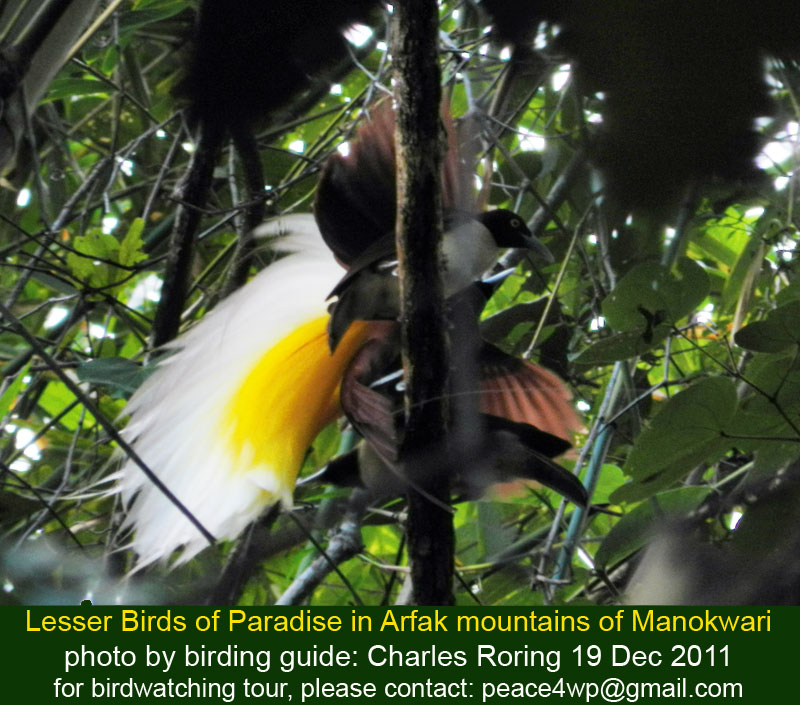
During the trip, we were able to watch Lesser Birds of Paradise (Paradisaea minor), Moluccan King Parrot (Alisterus amboinensis), Papuan hornbill (Rhyticeros plicatus), Grey Crow (Corvus tristis), Sulphur Crested Cockatoo (Cacatua galerita). There are also other birds that we could not identify because they were too far from us and I did not use binoculars to magnify their images. We heard the sound of Magnificent Riflebird (Ptiloris magnificus). Unfortunately, we were not able to find the bird.
In addition to birds, the jungle of Imubri is also the natural habitat of tree kangaroo, and cuscus possum.
Trekking
The rainforest of Imubri is now open to tourists who are interested in rainforest, wild animals of New Guinea and birds. Those who want to go there have to be physically fit. The forest consists of very steep slopes and deep ravines.  Visitors need to wear durable trekking shoes. We often walk along the ridge of the mountains, and climb steep slopes of the mountains with elevation up to 75 or even 80 degrees. In this case, visitors are highly advised to walk slowly and carefully.

What you need to bring
  • Portable folding/ dome tent
  • Sleeping bag
  • Mosquito net
  • Biscuits, water and other kind of ready prepared food
  • Binoculars
  • Camera with superzoom lens such as Nikon Coolpix P900 or other D-SLR camera with telephoto lens
  • Insect repellent lotion
If you are interested in trekking in Imumbri forest of Arfak range of Manokwari, and need me as your guide, please, contact me by cell phone/ whatsapp to +6281332245180 or email to: peace4wp@gmail.com

Sunday, July 10, 2016

Trekking and Watching Tree Kangaroo in Arfak Mountains of Manokwari

I used to guide a visitor named Tia on a trekking tour to Imubri area of Arfak mountains of Manokwari. We went trekking in the jungle for a few days. Our goal was to see tree kangaroo but we were also interested in seeing tropical trees, shrubs, vines, wild flowers as well as birds, insects, mammals and marsupial animals.
We started our tour early in the morning. Accompanied by local people, we began walking into dense forest of Arfak mountains. At first, the path was only flat. After 30 minutes of walking, the path was leading us to steep slopes. Our walking speed was getting slower as the slopes were getting steeper.

Blyth's Hornbills
After walking for one hour we reached a flat ground again. It was almost eight o'clock in the morning but the surrounding area looked darker. Only very little sunlight that could penetrate through the canopy of the forest. Suddenly, I heard sounds of big birds flapping their wings in the branches of the tree in front of us. Several Blyth's hornbills, perhaps after hearing noise from our voices, jumped from the tree and began flying away. They looked awesome while flying. I had not finished admiring the beautiful birds when I saw another attraction on the ground. There were some pink wild flowers that were coming out of green plants. I could not identify its species name. There were also butterflies that were flying in the air. We might have disturbed them from daily routines of collecting nectar from the flowers.

deep ravine in Arfak range of Manokwari
We walked up and down numerous steep slopes and crossed small and big rivers. In the middle of the day, we stopped at the side of a fast flowing river to have lunch.  It was the last river that we would cross. After lunch, we climbed very steep slopes again until we reached our base-camp located very deep in tropical rainforest of Imubri. It took around 7 hours of walking up and down steep slopes, for us to reach our destination. 

Tree Kangaroo in Arfak range
Tree Kangaroo
We still had some walking tours in the jungle to watch birds of paradise, butterflies and most importantly the tree kangaroos. The indigenous people were very smart in locating where the kangaroos were. They used dogs. Dogs that were trained to hunt animals in the jungle could sense the smell of tree kangaroos even though  the animals were sitting in the branches of high trees. When the dog found a tree kangaroo, we could see scratches of claw prints on the trunk of the tree.
Taking pictures of the kangaroo was quite difficult. I had to adjust my camera several times and aimed it at the marsupial animal located high above my head. After several attempts, I could make some nice photographs of the tree kangaroo (Dendrolagus ursinus). It was eating young leaves. He saw us on the ground but did not move away from us. Perhaps he was curious about what we were doing down there.
Lesser Birds of Paradise (Paradisaea minor)
We were very happy with the trekking tour in Imubri area of Arfak mountains because we could see tree kangaroo in their natural habitat. We did not see flame bowerbird but it was ok. Overall the trip to watch wild animals was tough or quite difficult as we had predicted it before. But we were satisfied with the experience. It was an adventure.
Birds of Paradise
The jungle of Arfak range is the natural habitat of various animals including several species of birds of paradise. Visitors need to bring binoculars if they want to watch the birds.

Where is Arfak range?
It is a mountaineous region in Manokwari, the capital of Papua Barat province of Indonesia. See the map below:

How to go there?
  • Fly from your country to Jakarta city (the capital of Indonesia)
  • Fly from Jakarta to Manokwari (there are regular flights served by  Garuda, Express Air, Sriwijaya Air)
  • I will meet you at the airport, or at the hotel where you stay and organize your tour to Arfak mountains
Are you interested?
Since 1800s Arfak has been a famous destination among foreign visitors. In the past, they came as researchers who wanted to study anything about New Guinea, its people, its flora and fauna and its land. Now most of the visitors are tourists. Only very few tourists would like to do long hours of walk to the jungle where tree kangaroes live.
Well, if you are interested, please, contact me (Charles Roring) by email to: peace4wp@gmail.com. Don't forget to do regular exercise before taking the rainforest tour with me.

Friday, March 22, 2013

Paradise Birds in Arfak Mountains

Located in the eastern part of the bird's head region of New Guinea, Arfak mountains can be considered as one of the best birding and trekking destinations in Indonesia. Several tour operators offer birding trip to the range which is only a 2-hour car trip from Manokwari city. Warmarway village that is located on the eastern coast of Arfak is a recommended place for watching Lesser Birds of Paradise (Paradisaea minor). The tree s where the birds like to gather stand on steep slopes approximately 400 meters above sea level. Birdwatchers have to cross a small river, walk up steep trails to reach the trees. A pair of binoculars, or a camera with telephoto lens is needed to caprture or make videos see the birds when they perform courtship dances.
Other lowland birds that can be seen flying over the canopy of the rainforest are Blyth's hornbill, Brahminy Kite (Haliastur indus); Sulphur Crested Cockatoo (Cacatua Galerita), frigate, and various species of kingfishers. 
The male Magnificent Birds of Paradise (Cicinnurus magnificus) that expands his feather and swings his blue antennas to impress female birds can be seen in the mornings in upper montane forest of Arfak range. Birdwatchers need to be physically fit to reach the birding ground of the bird. The indigenous people in Arfak mountains call it: knang bird.
Before the morning or afternoon shows, male Magnificent BOP has to clear the ground from fallen leaves or twigs.
Local guides can build birding hut (blind) for visitors who want to watch the Magnificent BOP. To increase the chance of sighting the birds, villagers put a red fruit (Pandanus conoideus) on a branch of a tree above the dancing ground of the birds. Birds of paradise like the fruit very much. It is not only the birds that eat the fruit but also humans.
Some researchers from Cendrawasih University even claim that red oil that is extracted from the red fruit is effective for curing patiens who suffer from cancer, HIV. Villagers in Papua have consumed red fruit oils for years. They add the oil to the vegetables that they cook and eat them with pork, or chicken and sweet potatoes. In recent years, the demand for the fruits is rising due to its medicinal merit.
As a tour guide, I have accompanied a lot of tourists on many birding trips to Arfak mountains and the North Coast of Manokwari. One day, I guided 2 Finish tourists. When they were sitting in a blind waiting for the male Magnificent BOP to come, suddenly they saw a female Lesser Birds of Paradise. It is a surprise for all of us to see her perching near the red fruit. It was the usual dancing ground of the Magnificent BOP but then a Lesser birds of paradise showed up. The red fruit that the villager had put could attract the bird. The photographer, Marko Laakonen, used a D-SLR camera that is powered with a telephoto lens to shoot the bird.
Besides watching birds, visitors can also see insects, buterfly and other animal such as Cuscus. Local guide - Yunus Sayori can attract male cuscus by imitating the voice of the female one.
Another important species of birds of paradise that can be seen in Arfak mountains is the Western Parotia. To attract females, a male Western Parotia has to perform a courtship dance. It looks like a classical ballet. He will shape his feather like a petticoat before dancing and shaking his head that is decorated with 6 antennas. His throat has got a glowing shield that reflects black, yellow and turquoise. His nose to forehead area is white. It looks contrast to his black feather. Its eyes are clear black with strong ring of blue around them. In Latin, it is called Parotia sefilata.

Other birds from Arfak Mountains
In addition to birds of paradise, birdwatchers can also see other species of birds such as Black Fantail, Hooded Pitohui, Feline Owlet-nightjar when they go trekking in the jungle.

Feline Owlet-nightjar in the forest of Arfak range

Black Fantail in Kwau forest of Arfak range
There are still more species of birds that we can see in Arfak mountains. To see them, we need to explore the jungle. Wear a good pair of sport or trekking shoes while walking in Arfak. Apply mosquito repellent lotion.

How to get to Arfak mountains?
You need to fly from your country to Jakarta - the capital of Indonesia. Then you can fly to Manokwari. There are several airlines that fly between Jakarta and Manokwari. They are the Lion Air, Express Air and Sriwijaya Air. When you arrive in Manokwari, you can meet me.  I can help you arrange your trip to Arfak especially to Warmarway village. For itineraries and prices, please contact me: Charles Roring/ E-mail: peace4wp@gmail.com

Sunday, July 31, 2011

Flowers from the rainforest of Arfak mountains in Manokwari regency

Flowers that are shown in the following photograph look like plumeria. I saw it at the top of Mt. Soyti. The mountain is part of the mountain range of Arfak. I was not able to identify it but later when a British girl from Kew Royal Botanic Garden visited Manokwari in her exploration of the flower plants in Arfak, she told me that these flowers are called Rhododendron. While updating this post, I did some research on the internet trying to find the name of the flowers. Finally, I found the answer. It is called Rhododendron Konori.
They emit soft pleasant scent when I moved my nose closer to them. I took the pictures of these flowers when I was climbing the Arfak mountains with some Swiss tourists last July. These rainforest flower plants grow in one of the tops of the Arfak mountains. At the top, the main vegetation are small flower plants, moss. There are various species of orchids too particularly in the elevation between 500 to 1000 meters above sea level.
Dense rainforest can be seen growing along the slopes of the mountains. Kwau village is one of the villages in District Minyambou of Manokwari regency that has become a favorite tourist destination. Besides these fragrant tropical flowers, I also saw other species .
In addition to admiring beautiful flowers, tourists who visit Manokwari regency of West Papua can enjoy various eco-tourism activities both in the coastal areas, the lowland and the highland of Arfak mountains. From snorkeling in Manokwari bay to hiking in the mountains, the coral reef and tropical rainforest of New Guinea island can give visitors a new experience about how wonderful it is to be closer to nature. As a tourist guide, I accompanied tourists from Switzerland, Poland and Finland last month. They watched the magnificent birds of paradise when they were in Arfak mountains.
If you are now planning of traveling to Indonesia, please consider West Papua province as one of your destinations. I will be happy to guide you and show you around how beautiful this western part of New Guinea island is. by Charles Roring

Also read:
Rainforest flowers blue trumpet vines
Flowers in My Neighborbood