Showing posts with label Tropical rainforest. Show all posts

Wednesday, October 31, 2012

Hiking in the tropical rainforest

Are you interested in hiking in tropical rainforest? If yes, then you need to read this post. I have guided a lot of tourists to various places in the jungle of New Guinea. I live in Manokwari, the capital of West Papua province. It is a recommended town for anybody who wants to explore the rainforest of this tropical island. New Guinea is the largest tropical island in the world. Its rainforest is the natural habitat of such animals as birds of paradise, tree kangaroo and deers.
Hiking and Camping Destinations
Senopi - This village is located between Manokwari and Sorong regencies. Now, it is a district in Tambrauw mountains. This is a highly recommended destination for visitors who want to go hiking and camping in the tropical rainforest. Birds of Paradise, Goliath Cockatoo, Deers and Cuscus are the animals that visitors may see while walking in the jungle of Senopi. When I and Wim (a Belgium tourist) along Kamundan river, we saw deers running into the woods. It was a fantastic experience for us after watching birds in Aiwatar hill.
Asai - This is a relatively new destination for hikers. Located in the north coast of Manokwari, Asai river is a nice place to watch Blyth's hornbills, and Sulphur Crested Cockatoo. Bring a tent if you want to stay in the jungle. Asai is also a nice place for tourists who want to do some snorkeling over its coral reef area.
Warmarway - Lesser Birds of Paradise live in the tropical rainforest of Warmarway. This is a small village that is located in the eastern coast of Arfak mountains. You can go there by public transporation. The slopes are quite steep so, you need to be physically fit to go there. Tents and cooking equipment have been prepared for tourists. So, you only need to buy food for you and the guides and porters for your hiking trip in the jungle.
Dopi river
This is a hiking destination that is not far from Manokwari. Visitors can do day trips and do not need to stay in the jungle. Apply insect repellent lotion all over your body before walking in the jungle.
Guides
I work as guide who arrange trips (including transportation, accommodation, food, and indigenous people as local guides) for tourists who want to go hiking in the tropical rainforest of West Papua. If I am not available for servicing you, I can contact other guides to accompany you traveling in Manokwari.

How to get there?
It's not difficult to go to Manokwari. First, you need to fly from your town or city to Jakarta. Then you can take a flight to Manokwari. Airlines that provide flight service between Jakarta and Manokwari are Lion Air, Sriwijaya Air and Express Air.

What I need to bring and wear?
Bring binoculars or digiscoping device if you want to watch birds or other animals that live in the trees. A GPS is also needed if you want to explore the jungle for several days. Wear sport shoes or hiking boots that are resistant to water. Put all your clothes and photographic equipment in a bagpack.


Travel Permit
Prepare photocopy of passport, visa and 2 pcs of recent photographs. You need them to get a surat jalan (or travel permit) from the local police in Manokwari.
Here is my e-mail: peace4wp@gmail.com if you want to make a hiking trip in the tropical rainforest of Manokwari.

Friday, December 9, 2011

Reforestation of Arfai coastal area

One of the fishermen in Manokwari who works with me in developing the eco-tourism program is Kosal Welerubun. He lives in Arfai area which has been a tourist destination since early 2010. I have been promoting Arfai as the place for snorkeling for tourists. Here, coral reef extends for 2 kilometers from north to south across the Raimuti islet. On the northern part of Arfai beach, there is a small mangrove forest whose size is getting smaller day by day due to the expansion of human settlement along the shore line. As a fisherman, Mr. Welerubun knows that the mangrove forest and the coral reef are an integrated marine ecosystem. If the mangrove forest is healthy, more fish can be found living among the coral reef. In addition, the existence of the mangrove forest will protect the shore line of Arfai from erosion caused by big waves or even tsunami. So, Mr. Welerubun made a personal initiative to plant seedlings of mangrove trees at the beach near his house. When I saw where he planted the seedlings, I felt that it would be very difficult for the mangrove seedlings to grow because they have to grow on in thick layers of dead hard corals. But Mr. Welerubun knows that beneath the layers of the hard coral is soft soil. So, the planted the seedling between the cracks of the coral layer. Cracks in the coral layers are created when there are big earthquakes.
One year after he planted the seedlings, I see that they are now growing. They give us some hope that the reforestation of the coastal area of Arfai with mangrove trees is possible to be done. I hope that these mangrove seedlings will one day become a tropical rainforest that protects the marine ecosystem of the Manokwari. Without the mangrove forest, the number of fish in Dorey bay will decrease. If this happens, fishermen will have to spend more fuel to go out to the sea for catching fish. As a result, the price of fish will be more expensive than now.
Coral reef is the tropical rainforest of the sea. Coral reef absorbs CO2 gases during photosynthesis and releases Oxygen. According to Bert Harris (a biologist from the USA who conducted a snorkeling trip in 2010) the coral reef in Arfai area of Manokwari is home to around two hundred species of fish. This is considered very high for the coral reef that is located near a coastal city.
Both coral reef and rainforest are needed to absorb CO2 gas emissions that have been the major cause of global warming. The effort of Mr. Kosal Welerubun in reforesting the coastal area of Arfai with mangrove trees should be considered as a positive step from the fisherman in fighting global warming. The climate change has caused the melting of glaciers in the Alps. The melting of the ice is a very big problem for ski resorts that operate there. The lack of ice forces them to close their businesses. In tropical region, global warming also causes coral bleaching. The phenomenon could easily be seen during the el-nino, the long dry season. As a result the number of fish in bleached corals decreased significantly. Every body should participate in reducing the CO2 emissions through his or her own ways. The simplest thing that we can do to protect our environment is by treating our plastic, chemical and metal wastes responsibly.
Manokwari city has a population of around 200 thousand people. The Arfai hill is now being filled with big buildings that will become the administration center of the provincial government of West Papua. by Charles Roring
Related article: Mangrove forest of Numfor island

Saturday, January 1, 2011

Tropical Rainforest Timber and Its Sustainable Extraction

I have written a lot of articles in this blog and my other websites about the promotion of ecotourism for the preservation of tropical rainforest and the providence of jobs in Manokwari regency and its surrounding region. From those articles, some tourists came last year and more have contacted me expressing their plans to see interesting tourist destinations and do activities that I had mentioned. As a matter of fact, the functions of forest are not limited to ecotourism. Tropical rainforest have been producing a lot of things that we need. Some of the rainforest products that have been extracted are wood and NTFP (Non Timber Forest Products such as rattan, rainforest flowers, mushrooms, medicinal plants, resins and wildlife animals)
Sustainable Extraction of Timber
People living in or around the rainforest build their homes using wood. Wood is one of the best construction materials in the world. From bookshelves to tables and from doors to floors, we can see many of the things in our houses are made of wood. I have stated many times in my articles that I am against deforestation. But it does not mean that I oppose timber extraction from forest. These issues are two different things. Based on my personal experience, I saw a lot of naturally fallen trees when I was guiding tourists in the Table Mountain. Yet, these trees are not extracted for their logs which are highly needed in the nearby Manokwari city. People working in the forestry department do not see these naturally fallen trees as important timber commodity that they can harvest from the forest to generate income both for the state and for the people living near the forest.

Process of Log Removal
I don't recommend the use of crawler tractors because they can inflict substantial damage on forest ecosystems. To minimize the destruction of other vegetation in the forest during the extraction of the wood, chainsaw operators can cut the fallen trees into smaller blocks and panels. These wood products can then be transported out of the felling site using cable system. Because there are no elephants, horses and water buffalos in Papua, local people can be employed to carry the wooden blocks and panels to the nearby road before they are transported to the saw mills in the city by logging trucks for further reprocessing works. During the colonial period, the Netherlands government had built roads inside the Table Mountain of Manokwari. These roads, if cleared, and maintained, can be used for the removal of timber and as track for tourists who are interested in hiking in the Table Mountain. 
Extraction of Fuelwood
Segments of branches and twigs that have been cut from the naturally fallen trees that are not used for home building and furniture can be taken by the people for fuel wood. Papuan children are often asked to help their parents collect firewood in the forest. For Papuan children, forest is not only the source of food and fuelwood but also their playground.
I support the extraction of wood from these naturally fallen trees because the removal of the wood will accelerate the recovery of the "naturally deforested" area. Wood from the naturally fallen trees can be used for fuel wood, home buildings and furniture. By wisely extracting timber from jungle, we can continually preserve the rainforest for future generations. by Charles Roring

Tuesday, December 21, 2010

Rainforest Hiking in Arfak Mountains of Manokwari regency

The mountain range of Arfak is a great hiking destination. There are a lot of trails which hikers can choose to hike through the tropical rainforest. The terrains consist of steep slopes with some valleys particularly in the Mokwam region. More moderate hiking trails are located on the south east of the mountains from District Oransbari to District Ransiki. Hiking tours in Arfak can be arranged to cater the needs of visitors depending on their physical condition and duration of their visit in Manokwari.
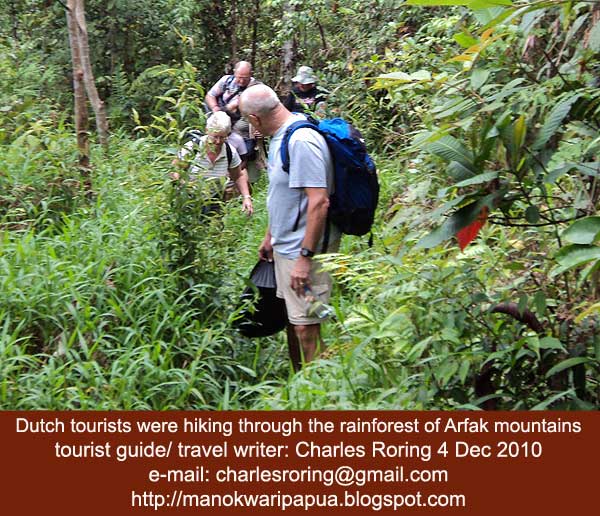
From 4 to 6 December 2010 I guided 7 Dutch and 1 Indonesian tourists to the tropical rainforest of Kwau village in Arfak mountains of Manokwari regency. Six of the Dutch were elderly people whose ages are between sixty to seventy years old. I had not known this until I met them on the 1 of December 2010. Well, I had planned a tour in the jungle whose terrain was more suitable for young age people. I felt a little bit guilty about it. I was not able to cancel the trip to Kwau village because Hans Mandacan already informed the villagers about our planned visitation.
So, on the 4 of December 2010, two 4WD cars - Toyota Hilux left Manokwari for Arfak mountains. These cars were very powerful in climbing the steep slopes of the Arfak mountains. In addition, the drivers whom I chose were the experienced ones. Along the way I was praying that these people would be able to walk through the rainforest, overcoming hills in front of them and finally arrive at Hans Mandacan's house. His house is not a luxurious rain forest resort equipped with complete facilities and fireplace cabins. It is only a simple 4-bed room house which Hans built by himself at a hill near Kwau village.
At around 13 p.m. we arrived on the road near a pathway leading to Hans' house. Around twenty villagers from Kwau village were waiting for us. They were women, men, boys and girls. They would carry our bags to Hans' house which he had changed into a temporary tourist house. We handed over our things to them and up we walked into the woods. Everything seemed to run well in the first ten minutes of the jungle walk. After that they began to ask whether the house was still far from our sight or not. We could only say that we were getting closer to the tourist house.
Birds were singing in the brances of the tropical trees. Perhaps they were enjoying the nectar of wild flowers or eating various forest fruits. December was time for fruiting season in West Papua. Birds and other rainforest animals were having parties with the abundant food that they had that month. Particularly for the magnificent birds of paradise, they like to eat red fruits. These old people were getting tired after ten minutes walking up several slopes of the Kwau village territory. It took one hour for the whole tourists to arrive in the tourist house. Besides it was far from the main road, the tourists often stopped for a while to take a rest or to see rainforest flowers, mushroom or anything that looked interesting in the jungle. When they arrived in the house, one of them complained to Sjaak (the coordinator of the tour) that the trekking route that day was too heavy for her.


So, if you plan to visit Arfak mountains, prepare yourself for a long rainforest hiking that will consume much of your energy in the slopes of the tropical rainforest. It is better to practice walking for at least three months before you go to West Papua. The duration of your walking practice can be 30 to 60 minutes. You will feel exhausted by that. Arfak mountains are rich of mammals, birds, reptiles and insect but they pose big challenges to those who want to explore their natural beauty.  by Charles Roring

Friday, December 17, 2010

Tropical rainforest Orchids

orchid of arfak mountains
Orchid Flower in Arfak range
Tropical rainforests in the mountains and islands across West Papua are now becoming the attention of biologists from around the world due to their essential functions in absorbing CO2 gases and  their natural wealth of biodiversity. The rainforest of New Guinea in the coastal and mountainous regions is rich a lot of species of flowers. Many of them are orchids. They grow on the branches of big trees twenty or thirty meters above the grounds. Due to the high demand of these tropical orchid flowers in the local and national markets, the indigenous people have collected large number of orchids and sell them in cities and towns of West Papua. These orchids plants will then be shipped to big cities in Java and sold in high prices. Because hunting orchids that naturally grow in the tropical rainforest will affect the balance of the rainforest ecosystem, there are efforts from the local Papuan themselves to cultivate these plants at their homes. By planting and growing orchids and other rainforest flowers, they can get increase the number of plants which they are able to sell. 
Although orchid farming is still considered as a small home business activity. Many people still do it in front of their home yards. There are not any companies in West Papua that have opened large areas of farmland to be used for cultivating orchid flowers.
A few months ago, there was an Orchid exhibition in Manokwari city organized by the government to promote orchid as a non-timber forest or agricultural products. Papua and West Papua provinces have a number of dendrobium orchid species that are expensive in such big cities as Jakarta, Surabaya and Denpasar. The local government want to promote the region as the major supplier of this tropical flower to improve the living condition of the flower farmer. 
Rainforest flower plant in tropical forest
Pseudo Bulb of Orchid
If you go hiking in the tropical rainforest of Arfak mountains, Table Mountain and the North Coast of Manokwari regency, you will be able to see various species of orchid plants in the jungle. Papuan people do not see orchid only as decorative plants. They use orchid fiber to make noken (string bags). The pseudo bulbs of orchid is also used by the islanders in Numfor island as herbal remedy for abscess. The pseudo bulbs contain sticky thick liquid than can be applied on the surface of one's skin that is suffering from abscess. The liquid will suck the pus and dry the wound without causing severe pain. 
Flower plant in tropical jungle of West Papua
Orchid Plant in A Tree in the Forest
So, next time when you see an orchid plant with its beautiful flowers, you will know that it is also a good herbal medicine. From the above story, we can conclude that the preservation of the tropical rainforest is not only important for fighting global warming through the absorption of CO2 gases but also for protecting the high biodiversity that it has for the improvement of the standard living condition of mankind. From the rainforest, we can get a lot of species of plants that have medicinal functions. Rainforests and global warming are two important issues that cannot be separated but the preservation of these rich environments is not limited to them. Simply, it is very important for all of us.
Orchid flowers in tropical jungle of West Papua
Terrestrial Orchid
On a separate trip into the rainforest of West Papua, I accompanied a young Biologist from the United Kingdom. Her name is Georgie. We went hiking through the jungle of Manokwari town. Our destination was the tropical rainforest of Dopi river on the west of the town. We saw fruit doves, pygmy parrots, Blyth's hornbills, butterflies, and various colours of terrestrial orchids. Perhaps, the one in the above photograph is Spathoglottis plicata. If you are looking for more information about orchids, try to buy some books at Amazon online store


Flower Tour in the Minahasa Highlands: From Tomohon to Tincep Village in Subdistrict Sonder

The Minahasa Highlands of North Sulawesi are among Indonesia’s most enchanting destinations — a region of cool mountain air, fertile volcanic soil, and landscapes painted with color. At the heart of this natural beauty lies a journey that every nature lover should experience: the **flower tour from Tomohon to Tincep Village in Sonder Subdistrict**. This route captures the essence of Minahasa’s floral richness, rural charm, and cultural warmth, offering visitors a vivid glimpse into a land where flowers bloom year-round.
Kengkang water fall in Tincep and bougainvillea flower garden
Waterfall, flower garden, birds and butterfly in Minahasa highland


1. Tomohon – The City of Flowers

Your flower journey begins in Tomohon, famously known as the “Kota Bunga” or “City of Flowers.” Nestled between Mount Lokon and Mount Mahawu, Tomohon enjoys a cool, misty climate — perfect for cultivating a stunning variety of flowers. As soon as you enter the city, you’re greeted by rows of colorful flower stalls and gardens that stretch across the hillsides.

One of the main attractions here is the **Tomohon Flower Gardens**, where local farmers and florists proudly display their blooms. The market bursts with colors — bright chrysanthemums, elegant roses, cheerful daisies, and exotic orchids. You can watch locals crafting beautiful arrangements or even purchase fresh bouquets directly from the growers.

Another highlight is the **Tomohon Flower Festival (TFF)**, held annually around August. During the festival, the city transforms into a floral paradise with floats, parades, and flower-themed exhibitions, showcasing the creativity and horticultural skills of the Minahasan people.

For those who prefer a more tranquil experience, visit **Kebun Raya Tomohon (Tomohon Botanical Garden)**. This expansive garden sits on the slopes of Mount Lokon and features native plants and flower species from across Sulawesi. Strolling along its paths, you’ll find rare orchids, begonias, and other tropical blooms set against panoramic views of the highlands.


2. The Scenic Route from Tomohon to Sonder

Leaving Tomohon, the road to **Sonder Subdistrict** winds through picturesque countryside dotted with traditional wooden houses. The journey, roughly 15 kilometers, offers magnificent views of the Minahasa Highlands — terraced fields, volcanic peaks, and flower farms that seem to merge seamlessly into the landscape.

Along the way, you’ll pass through small farming communities such as Rurukan and Tombariri, where flowers are cultivated not just for sale but as part of daily life. Villagers often plant bright marigolds, bougainvilleas, and zinnias around their homes, giving the entire journey a colorful, festive feel.


As you descend toward Sonder, you’ll notice an increase in the number of flower gardens and nurseries. Many of these are small family-owned farms that grow flowers for local markets, religious ceremonies, and special events throughout North Sulawesi. Visitors are often welcome to stop, take photos, and even purchase freshly cut flowers directly from the farmers.

Flowers that are offered for sale 

3. Tincep Village – The Heart of Rural Floral Beauty

Your final destination, **Tincep Village**, is one of the most charming villages in the **Sonder Subdistrict**. Known for its fertile soil, Tincep has long been a center of agriculture — producing not only vegetables and spices but also an impressive variety of flowers. The village sits in a lush valley surrounded by hills, with a cool breeze and constant fragrance of blooming flora.

The villagers of Tincep take pride in their flower gardens, which are often small but vibrant. Here, you’ll find roses, celosia, chrysanthemums, dahlias, sunflowers, bougainvillea, flourishing side by side. The simplicity of these rural flower farms contrasts beautifully with the grandeur of Tomohon’s larger gardens, offering visitors a peaceful and authentic countryside experience.

Many locals in Tincep are happy to invite visitors into their gardens. You can learn how flowers are cultivated, cared for, and harvested — often using traditional methods passed down through generations. Some residents even offer garden tour, allowing you to see closely how they tend various flower plants at their front, side and back yards.

In addition to flowers, Tincep is also known for its **organic farming practices** and **community-based tourism** initiatives. Visitors can take guided walks around the village, enjoy traditional Minahasan dishes like *Tinutuan* (vegetable porridge) and *Ikan Woku* (spicy fish stew), or relax in small homestays surrounded by nature.

bougainvillea in Tincep village of Minahasa
Tropical flowers at the frontyard of the villagers' houses in Minahasa highland

4. The Culture and Charm of Sonder

While the flowers are the main attraction, the wider **Sonder Subdistrict** has its own unique appeal. The people of Sonder are known for their friendliness and hospitality. Local traditions are still alive — from **Minahasan wooden house craftsmanship** to **traditional dances and music** that often accompany village celebrations.

If you visit on a Sunday, you might hear church bells ringing across the hills — a reflection of the community’s deep-rooted Christian faith, harmoniously coexisting with their respect for nature. The villages in Sonder are also famous for their clean, well-maintained surroundings, often adorned with ornamental plants and flowering shrubs that brighten every corner.


5. Best Time to Visit

The Minahasa Highlands enjoy a mild climate throughout the year. During April to November, the skies are often clear, and most flowers are in full bloom. If you visit in August, you might also catch the **Tomohon Flower Festival**, making your trip even more memorable.


6. Travel Tips
  • Flight Routes: Visitors who are interested in taking this flower tour need to fly to Manado city which is the capital of North Sulawesi Province, Indonesia. International Direct flight is available between Singapore and Manado city served by  Scoot Air. Another route is from Guangzhou and Manado city served by China Southern Airlines and TransNusa. For domestic flights, there are regular daily flights between Manado and major cities in Indonesia such as Jakarta, Surabaya, Denpasar, Makassar, Balikpapan and Sorong city. 
Flight route to Manado city from Singapore, Jakarta, Surabaya, Makassar, Denpasar, Sorong
Flying to Manado city
  • Getting There: Tomohon is about 45 minutes from Manado by car. From Tomohon, the drive to Tincep Village in Sonder takes approximately 30–40 minutes. You can rent a car or motorbike, or hire a local guide to explore the area.
  • Accommodation: Tomohon has various hotels, guesthouses, and eco-lodges. For a more authentic experience, consider staying overnight in a **village homestay** in Tincep or Sonder.
What to Bring: Comfortable walking shoes, a hat, a light jacket (as the weather can get cool), and a camera to capture the scenic landscapes.
Respect Local Customs: Always ask for permission before entering private flower gardens, and support local farmers by buying their flowers or handmade souvenirs.


7. A Journey of Color and Calm

The flower tour from **Tomohon to Tincep Village** is more than a scenic drive — it’s an immersion into the heart of Minahasa’s natural beauty and local life. From the bustling flower markets of Tomohon to the peaceful gardens of Tincep, the journey reveals how deeply flowers are woven into the region’s culture and identity.

Here, every bloom tells a story — of volcanic soil that nourishes life, of mountain breezes that carry the scent of nature, and of people whose love for flowers has turned the Minahasa Highlands into a living garden.

Whether you’re a photographer, a flower enthusiast, or simply someone seeking tranquility, a flower tour through **Tomohon and Sonder** will leave you refreshed, inspired, and enchanted by the endless colors of North Sulawesi’s highlands. 🌸

Booking
The duration of this tour is as short as 1 day to as long as 3 days to see most of the flower varieties that local farmers grow. This tour can be combined with sightseeing tour in Minahasa highland as well as birdwatching and butterfly watching in Mount Mahawu, Mount Lengkoan of Minahasa highland, The outskirts of Manado city and Tangkoko Nature Reserve. 
To book your tour, please, contact: Charles Roring by email to: peace4wp@gmail.com


Saturday, December 11, 2010

Tropical Rainforest Lizard

As a tourist guide and travel writer, I like to go hiking and guiding tourists around the tropical rainforest of New Guinea island. This island is also called Papua or West Papua. Today, Papua as the largest tropical island in the world is administered by two countries. The eastern half is the independent state of Papua New Guinea whereas the western half is the territory of the Republic of Indonesia that consists of two provinces Papua and West Papua. The capital of West Papua is Manokwari city. I discuss a lot of topics about tropical rainforest that covers the mountains and plains around the city. 
While guiding tourists, I like to take pictures of animals, flowers, mushrooms, birds, insects, trees, unique leaves of the vegetation and the tourists whom I guide. Today, I am going to tell you a little story about lizard. There are many species of lizards in the tropical rainforest of Papua. As reptiles, small lizards usually eat insects. They can climb trees fast. Some lizards have skin surface that are adapted to the play where they live. If a lizard attaches itself on a tree trunk whose color is green brown, its skin color will adapt to the color of the host tree. This is one of the ways which some lizards do to protect themselves from being the prey of their predators. 
The tropical island of Papua has big lizards which the indigenous people like hunt and eat their meat. These big lizards are called Soa-Soa. Soa-soa do not eat insects. Instead they eat the meat of dead animals such as small forest mouse, other small reptiles and dead birds. In the tropical rainforest food chain, soa-soa lizards are the prey of big birds such as hawk or eagle. 
The photograph above shows how a green tree lizard catches an insect in a tree in the tropical rainforest of the Table Mountain. Sometimes small butterflies that eat nectar for rainforest flowers become the target of the lizards. This is the usual food chain that always happen in the jungle. We cannot stop them because it naturally occurs every day.
The indigenous Papuan people have a unique technique in catching soa-soa. They don't use modern air guns instead, they use lasso trap which they set on the ground. Usually they make a least 20 traps placed in one row and cut small vegetation to make a small fence between the traps. The distance between two traps is around five to ten meters. When the lizard walk on the ground and face the fence, they will change their direction to find a clear ground the pass through. Then they will as a clear ground, where the hunter of lizards has set up his trap. If the lizard pass through the trap, it will step on the pin that triggers the wooden stick of the trap to pull the lasso made of a smooth nylon string. As a result, the lizard's head, or leg or even main body will be caught by the lasso. 
The next morning when the hunter comes to check his traps, he will find the lizard which is a good meat for his family. So, if you are interested in hiking in the tropical rainforest of Arfak mountains, Table Mountain and the Nort Coast of West Papua to see lizards or other animals, you can contact me - Charles Roring - via my e-mail charlesroring@gmail.com. I will be happy to be your guide in this beautiful tropical island.
Also read: Birds from the Tropical Rainforest of Manokwari Papua  

Tropical rainforest butterflies

Every time I go hiking in the tropical rainforest of Arfak Mountains or Table Mountain or the Northern Coast of Manokwari regency, I will see a lot of species of butterflies. They are really beautiful. Butterfly come out of their places in the morning at around ten. They feed on the nectar of wild flowers in the rainforest. Although in the international market, the price of butterfly from the tropical rainforest of West Papua is high, I personally not interested in catching them for export. Butterflies sleep on top or underneath the green leaves of plants in the jungle. Some even spread their wings to resemble the leaves. The colors of their wings are various. There are butterflies whose colors are brown and yellow but there is also a species whose color is purely white. 
Last September, two researchers from the University of Milan in Italy visited Manokwari to study butterflies. They liked to catch the butterflies. The butterflies which they had caught were then kept in white paper and put into a small plastic container. Ivan, one of the researchers, could mention the name or the genus of the species. He was lucky when he could catch a troides. Because I did not know anything about the butterfly kingdom, I could only say that I could tolerate his action in catching these insects if they are purely for the purpose of research. Butterflies play very important role in supporting the pollination of flowers in the tropical rainforest. 

Besides butterflies, other insect that also does similar function is bee. The nectar which the bee has collected will become delicious honey that is good for our health. Based on the observation of the important function of butterflies on the survivability of tropical rainforest, I appeal to all the people who like to go hiking in the tropical rainforest to respect butterflies but not catching or disturbing them. While these tiny and weak insects help the pollination of flowers thus accelerating the fruiting process, the birds that eat the fruits help disperse the seeds of the fruits. 
Rainforest of Arfak mountains and the northern coast of Manokwari regency in Indonesia are often visited by tourists who want to see bird wing  butterflies and birds. This kind of ecotourism activities directly gives economic benefits to the local people living in and around the forest. By introducing ecotourism into the region, I hope that together with the indigenous Papuan people, we can preserve the forest and still make a living from it. 
Also read:
Tropical rainforest a great tourist attraction in Manokwari Papua
Butterfly watching in Manokwari's Table Mountain
Butterfly watching in Manokwari

Wednesday, December 8, 2010

Rainforest insects

Last November I and Monique (a volunteer from SDSP foundation) went hiking in the tropical rainforest of the Table Mountain near Manokwari city, the capital of West Papua province. We walked along the road that divides the jungle into two parts. Table Mountain with its forest is the closest natural environment that still exists in the city. The tropical rainforest that covers that mountain is rich of insects such as beetles, butterflies and wasps. Butterflies like to feed on nectars of rainforest flowers. During the morning walk with Monique, we could see various kinds of grasshoppers that like to eat young green leaves of plants and trees that grow in the forest. When the rainy season comes, trees and small vegetation grow faster. This creates competition between small plants and big trees. The presence of grasshopper can balance such competition by feeding on young leaves of the trees and plants that grow faster than others. In the food chain, insects such as the grasshopper are delicious food for lizards and soa-soa whereas these reptiles are prey to snakes and big birds.
When I write this post, I remember reading a book entitled the Malay Archipelago by Alfred Russel Wallace. In a chapter about the Netherlands New Guinea, he said that this Table Mountain is rich of insects. Yes, I can confirm his report here that there are still a lot of species of insects in this tropical rainforest.
European researchers have visited the Table Mountain of Manokwari since two centuries ago. One of them was Prince Leopold and Princess Astrid from Belgium in 1929. Prince Leopold collected a lot of animals, including insects in Manokwari. His collections can still be seen in ISNB Brussels.
I write this post to promote ecotourism and attract tourists from around the world to visit this forest. If you are interested in watching beetles, butterflies, and various other insects in this tropical rainforest, you can contact me via my email: peace4wp@gmail.com. I will be happy to arrange your trip around Manokwari and guide you to see the beauty of Papua's nature. by Charles Roring

Also read:

Thursday, December 2, 2010

Tropical rainforest of Kaki island

Kaki island is a small tropical islet located near Nuni village of the north coast of Manokwari regency. This coral island is still covered with beautiful tropical rainforest that protects it from erosion. Most of the vegetations that we can see in the Kaki island are coconut, ketapang (catappa) and barringtonia asiatica.
To help the indigenous people in the northern coast preserve the tiny rainforest of the island, I try to introduce ecotourism project. I intend to bring foreign tourists there where they can enjoy hiking through the tropical rainforest and bird watching around the coast in the island. In addition to birds, in the morning we can see butterflies eat nectar of flowers both in the Nuni village or in the surrounding forest of the mainland New Guinea.
Besides the beautiful jungle, pristine coral reef can be found thriving around the island. As the tropical rainforest of the sea, coral reef absorbs large amount of carbon dioxide while doing photosynthesis. With eco-tourism scheme, tourists who want to go snorkeling around the island will be transported by motorized outrigger boats that are operated by the local fishermen's there. This additional income will help the fishermen to improve their living condition, and send their children to school without having to exploit the coral reef and the forest of Kaki island too much.
Besides snorkeling, bird watching and hiking, another ecotourism scheme that I can introduce in Nuni village is surfing. Waves in the northern coast reach its highest point between December and February. With more nature lovers and foreigners come to the region, more money can be injected into the local economy through ecotourism project. The interaction between the local people and the tourists can bring new possibilities of raising the awareness about the importance of preserving the environment of the tropical rainforest and the coral reef. The number of tourists visiting Kaki island is not high at the present moment but I expect it to rise next year.
Also read:
Tropical rainforest picture of Numpuri islet
Tropical rainforest of Asai river
Tropical rainforest of Numfor island

Monday, November 29, 2010

Rainforest flowers pictures

Still on my discussion about rainforest flowers, the pictures that I got from morning walk near the tropical rainforest of Numfor island were quite interesting. I saw bougenville and rose-apple. For many of you, bougenville might not be a new tropical flower for you. Everybody recognizes it. It is not difficult to grow it. Flower growers like to join a number of twigs from different colors of bougenville into one plant. An adult bougenville can reach up to 3 meters height. Although it does not have strong fragrant, it is still attractive to all of us because it produces a lot of flowers. To grow buogenville just insert a stick of buogenville into loose soil and let it grow naturally. This bush plant needs water but it does not like wet ground.
Another tree flower that I saw in Numfor was rose-apple. Its flowers were red. They would change into fruits in a few weeks. Some species have sweet taste but most are sour. In Indonesia, the fruits of rose-apple are mostly used as ingridients in rujak (a kind of fruit salad) whose taste is a mixture of sweet, hot and spicy. Birds also like to eat the rose apple very much. Because the tropical rainforest of New Guinea has a lot of beautiful flowers, I will take more pictures of them if I do a morning walk again both in Manokwari or in Numfor island.
Also read:
  • Beach hibiscus
  • Barringtonia Asiatica

Monday, November 22, 2010

Tropical rainforest of Asai river

Tropical rainforests around the world are now being threatened by massive deforestation at a rate of 50 football fields per minute (Julie Kerr Casper in "Global Warming - Changing Ecosystem" 2010). To stop this, all the world communities must work together. There are a number of ways that we can do to reduce the deforestation and illegal logging. We can change our lifestyle by living more friendly to the environment, by designing more efficient burning stoves that consume less fuel wood or by planting more trees.
I and several nature lovers from a Dutch foundation try to introduce ecotourism as an alternative income generation for the local West Papuan people living in the north coast of Manokwari. We expect that with additional income from the forest tourism, the indigenous people in this largest tropical island in the world will not be tempted to give up their rainforest for timber exploitation and large scale monoculture plantation.
Yesterday morning, I went hiking with Monique and Jetty (two volunteers of SDSP foundation from the Netherlands) along the Asai river. Both sides of the river are covered with tropical rainforest. Our intention to go hiking along the river was to survey and determine whether the area is feasible to be developed as another tourist destination in Manokwari, the capital of West Papua province of the Republic of Indonesia. As a matter of fact that was my third visit. For these Dutch girls, it was their first one. We went there by a rent car. It took around one hour from Manokwari city to Asai. Arriving at the bridge, I got off the car to meet Oom Minggus. (He is usually called Oom Ambon by the local villagers). I informed him that I and two Dutch volunteers wanted to explore the rainforest and the river. Oom Ambon offered to accompany us. I was not aware that two of his dogs were following us.
Because the sea was in high tide, the sea water entered the river making the water level near the estuary area reached 1.5 to 2 meters. So, it was not possible for us to start hiking from the bank of the river. We had to use the pathway not far from the river whose slope was quite steep. It was not easy for Jetty because she had problems with her right knee. I felt guilty because of that. After climbing up and walking down some slopes, finally we could reach the bank of the river. The water was clear and shallow a little bit far from the estuary region. Its an ideal place to swim there because the outdoor environment was still in pristine condition. I saw several hornbills flying above our heads. We could see them by our naked eyes. Seeing the water, the dogs began barking. They did not like crossing the stream. Their barking made the birds flew away. I was a little disappointed but now the chance for shooting the birds was very little. The word shooting should not be considered as killing the birds but capturing their images using digital cameras. Om Ambon tried to chase the dogs away but they did not want to return to their master's home.
Although we were disappointed by the barkings of the dogs, we were quite happy to see the beautiful nature of the river and of the forest that looked dark green around us. The air was really fresh. Several times, we had to cross the river, climb big rocks or walk on fallen trees. This is a nice trekking route for tourists who like to explore both the jungle and the water environment of West Papua. We also had to be extra careful while crossing the river because the stones at the river bed were slippery. If you are interested in hiking along this river, please, contact me: Charles Roring - via email: peace4wp@gmail.com. Don't forget to wear water shoes or hiking boots. If possible, cover your digital still photo camera with a good waterproof case.
Also read:
Tropical rainforest in the mountains
Tropical rainforest of Arfak mountains
Tropical rainforest of Numfor island

Thursday, November 4, 2010

Traveling to Numfor island and Snorkeling in Manem islet

I and three tourists from the Netherlands (Wally, Trudy and Lian Schepers), together with some Papua as boat drivers, went to Manem island on 28 October 2010. We enjoyed swimming and snorkeling in its surrounding waters. The coral reef is still in very good condition making it an ideal place for tourists who want to take underwater pictures. Coral reef is the tropical rainforest of the ocean. It is the natural habitat of various species of marine plants and animals. When it carries out photosynthesis, it absorbs CO2 gases from the atmosphere that have already been dissolved through contacts with the sea water at the surface level. In other words, coral reef's function is the same as tropical rainforest. Its biodiversity is even higher than the rainforests. Because there is no diving center in Numfor, scuba divers and snorkelers must bring their own gears.
 

If there are any of you who want to travel to this tropical island and need a guide, please, contact me - Charles Roring - via an e-mail peace4wp@gmail.com, I will be happy to arrange your trip there and to be your guide while traveling around this beautiful tropical paradise.

Also read:

Monday, November 1, 2010

Tropical Rainforest as the Source of Papuan Music Inspiration - Part 4

The tropical rainforest of Numfor island is not only the source of food but also the source of art inspiration. Papuan musicians have created songs as part of their appreciation and love to the beauty of the nature and the rainforest.
When we went to see rusted machine guns and bombs which were World War II ordnance left by the American and the Japanese forces, we saw some traditional Papuan guitars at Mr. Simon Wanma's house. According to his explanation, the Papuan musicians like to come to his house at night to practice playing and singing their traditional songs. I found it interesting so I suggested to the Schepers whether they would come at night. They agreed that after eating dinner, they would come to see the "traditional Papuan music performance."
At night around 9 p.m. we walked to Mr. Simon Wanma's house again. After fifteen minutes walking, I told the Schepers that I need to stop by Piet Rumbiak's house to meet him for arranging the next day trip to Manem island where we would swim and snorkel around the coral reef which is the tropical rainforest of the ocean. So, I stopped at Mr. Rumbiak's house whereas the Schepers continued walking to Mr. Wanma's house.
Mr. Rumbiak was talking on the phone near the beach at the back of his house when I arrived. A few minutes later, we were discussing things related to our next day trip to Manem island. He suggested that we buy gasoline and oil in Yemburwo village before going to find a boat in villages that are located closer to the Manem island. When everything had been settled or arranged I left him for Mr. Wanma's house. It was not far and I only needed less than five minutes to find the house. It was quite. The Schepers had just been there less then five minutes too. I thought I walked faster than them. Well, the music performance had not been started. Perhaps it was because of the rain that was pouring over the village one hour ago.
Mr. Wanma went out of his house and told some of his assistants to call the musicians. They quickly rode bicycles to find the musicians and brought them to Mr. Wanma's house. Around fifteen to twenty minutes later, most of the musicians came. They set their instruments and made some preparations for the night's performance. I was amazed to see that they didn't need a lot of directions from their leader. Mr. Simon Wanma was their tribal leader but he might not be a musician. So, there has to be a leader among the music players but I could not find which one he was.
First they started playing their music instruments. All of them look like guitars but each has different size and function. Bass player was sitting on the floor with a cigarette between his fingers. They were playing and singing for around thirty minutes without any brake. It's amazing. Their songs are messages to Papuan especially the Biak tribe to love their lands, their tropical rainforest and their sea. The tropical rainforest and its surrounding nature is home not only to the animals but also to them as the indigenous people who have been living in the Biak, Numfor (Schouten) islands for generations.  
After listening to the songs, Wally Schepers sang one song (in English language) to them. Before going back to the losmen of Klasis Numfor, the Schepers said that they would try to invite these musicians to the Netherlands. by Charles Roring
Also read: 
Part 1: Traveling to Numfor Island: Tropical Rainforest and Coral Reef
Part 2: Bird watching in tropical rainforest of Numfor island
Part 3: Tropical rainforest of Numfor island the battle ground between the US and the Japanese forces during WWII

Tropical Rainforest of Numfor Island - the battle ground between the US and the Japanese Forces - Part 3

Between 1941-1944 Japanese occupied New Guinea island including the Numfor island that was still covered with tropical rainforest. Only small groups of Dutch troops that still continued the guerrilla fighting in the surrounding jungle of Manokwari. All of the Dutch troops in the Netherlands Nieuw Guinea had surrendered to the Japanese troops. Entering the 1943 and 1944, the American forces fought back. First they pushed the Imperial Japanese Navy out of Guadalcanal of Solomon islands, and Papua New Guinea. Second they entered Western half of the island in 1944. Hollandia was their first target, then Biak and Numfor islands. The Japanese troops had built air strips in this island and hid in the caves located in the tropical rainforest of the island. To defeat the Japanese, the American forces launched massive bombings and landed thousands of troops. It was not easy for both sides of the warring parties especially for the Japanese.  Many of the soldiers died not because of fierce gun fighting but malaria and lack of food. The Japanese army were defeated easily overwhelmed in number of troops and weapon technology. Well, that's a little story about war in the tropical rainforest of Numfor island.
Also read:
Part 1 Numfor Island Tropical Rainforest and Coral Reef
Part 2 Bird Watching in Tropical Rainforest of Numfor Island
I returned to my homestay after drinking coconut juice at Penginapan Klasis with the Schepers family. The homestay is located at the south of the Numfor airport. It belongs to Yonathan Rumbewas, a Papuan who works as construction worker. He built his house near the tropical rainforest which in the morning is always filled with the sounds of various species of birds. Coconut trees grow around his house creating a peaceful and cool atmosphere. Although during the mid-day the temperature of this tropical island is quite hot, the house stays cool due to a lot of green vegetation around it. The trees of the tropical rainforest absorb the CO2 gases during the photosynthesis and emit fresh oxygen that can be felt in the houses that are located near the forest.
In the afternoon, I walked to the Penginapan Klasis again to meet the Schepers. They were not there. There were at an eating house across from the losmen. I went there to offer another day trip to visit "World War II Museum" at Mr. Simon Wanma's house. They invited me to have lunch in that "rumah makan." I ate rice, carrot and cabbage soup and fried fish covered with chilli sauce. They ate noodle soup. They complained that they could not always eat rice. In addition the chili sauce was too hot for them. So, I decided to ask the woman to arrange food for the next days that is more suitable for them. She agreed to help them by making fried sukun (bread fruit), vegetables, and pisang goreng. With this arrangement, the Schepers could enjoy their food well.
After having lunch, I went out to find a public transportation that could carry us to Simon Wanma's house. I met someone named Piet Rumbiak. He was an old "taxi" driver. His car was a minivan Suzuki Carry. He was glad to meet these Dutch tourists. When I mentioned that Mr. Wally Schepers was born in Manokwari, Piet said that he used to live in Manokwari.
Fifteen minutes later, we were now at the World War II "Museum." Mr. Wanma bought some old machine guns and other ordnance from the local Papuans to avoid them from being sold to old iron buyers where they would be smelted and recycled to produce new metal products. For Mr. Simon Wanma, these old guns and bombs should be preserved for future generations of Numfor people so that they will know the history of the island. Fortunately these rustic machine guns and bomb could not be used anymore. by Charles Roring

Also read:

Sunday, October 31, 2010

Bird Watching in Tropical Rainforest of Numfor Island - Part 2

The tropical island of Numfor is the natural habitat of hundreds of species of coastal or rainforest birds. The rainforest depends on them as fertilizer and seed dispersers and at the same time the birds depend on the rainforest as their home. Sea birds eat fish. Their feces are very good fertilizer to the soil of the island. This post is my second story about Traveling in Numfor island. The first one was Numfor island Tropical Rainforest and Coral Reef - Part 1.
Eclectus Parrot
Eclectus Parrot
The three tourists left the ferry boat and walked through the crowd of passengers and their relatives who came to the harbor to welcome them. When we were on the pier, I told Lian Schepers that they should buy some fish for dinner. She agreed with that and bought some fish. Their price was 20 thousand rupiahs. I had to find a car which would bring them to Yemburwo village located in the north of the island.
Ferry boat Kasuari Pasifik IV
I finally could find one. After negotiating the price with the driver, we agreed to pay 25 thousand rupiahs per person for the 1.5 hour ride to the district capital of East Numfor. The number of passengers which the car carried was 15 people not including the luggages between our legs and on the roof of the car. Actually the normal carrying capacity of this public transportation is 10 but the driver needed more money to stay profitable in this business by carrying more goods and more people. Personally, I was worried that this over capacity could create an accident but fortunately everything was just fine.
Boat harbor in Numfor islans
We arrived in Yemburwo village when it had been dark. It was a large coastal village located along the beach of the Numfor island. Mr. Rumbewas who manages the penginapan klasis (that belongs to GKI church) had to repair the water pump and clean and the tub before the tourists could use them for taking a shower. Lian gave the fish to Mr. Rumbewas where they would be fried for their dinner. I left them at around 9 p.m. after informing them that the next morning activity would be bird watching along the road outside the Yemburwo village. When I left them, the fried fish had not come. I stayed in Mr. Yonathan Rumbewas' home. As a host family, he was very helpful.
Willie Wagtail
Willie Wagtail
The next morning, I came to the Penginapan Klasis to meet the Dutch tourists to guide them for a bird watching trip not far from the village. I was accompanied by Hari Wanma, a relative of Yonathan Rumbewas. Lian Schepers told me the fried fish came at 11 p.m. too late for dinner. She gave them to the dogs. At around 6 a.m. we walked to the west of the village. Some of the villagers had come out of their houses perhaps to catch some fish at the beach during the low tide for their breakfast.
Japanese War Memorial
Numfor island was a battle ground between the US and the Japanese forces during World War II. While walking along the road that devides the Yemburwo village into two parts, I saw a Japanese World War II Memorial Monument. I shot some pictures of it. I don't know the meaning of the inscription written on the monument but I believe that it was to honor the Japanese soldiers who had fallen on the island during fierce battles against the US forces.
Some birds were flying above our heads. Black birds with white color on their chests and stomachs. They had white eyebrows.  The most common species that we saw that morning. They were Willie Wagtail (Rhipidura leucophrys). They were playing on both sides of the roads on the fences of the houses or on the lower branches of the trees. Two red lories flew to the coconut trees that grow along the beach. They were female Black-capped Lory. I really regretted of not carrying a long lens camera during my tour to Numfor. Next time, when I go to this tropical island again, I will bring a better camera.
We also saw a black bird. It was Torresian Crow. However, I prefered to call it crab eater. The Back bird often landed on the road near a swamp just outside the Yemburwo village. Crabs frequently crossed the swamp. In another occasion, I saw Numfor Paradise Kingfisher in the forest not far from the airport.
Mr. Schepers told me whether they could buy some fruits in the island for their breakfast. When we passed by a house, we stopped and asked an old man who was working as ojek driver (ojek was a motorcycle taxi) to find fruits in the nearby village. He promised to find them for the Schepers. We return to the Losmen Klassis at around 10 a.m. One hour later, the ojek driver brought some papaya fruits. We already had some coconuts picked by Hari Wanma our Papuan tour guide that morning.
Introducing bird watching trips for tourists to Numfor island is important to help the local Papuan preserve the birds there. I see that the population of birds in the island is being threatened due to bird trading. The local Papuan youth catch the birds and sell them to buyers in Biak town and Manokwari city. If more tourists come to watch birds in the tropical rainforest of Numfor island, I believe that the hunting of birds can be stopped. by Charles Roring
Related posts:
Traditional Dancers and Musicians from Numfor island
Mangrove Forest from Numfor Island
Snorkeling and Birdwatching Vacation to Numfor island
Tropical Rainforest of Numfor island - the Battle Ground between the US and the Japanese Forces - Part 3