Last Christmas, I gave a mountain bike tour to an Indonesian tourist. His name was Danang. He worked for Datascript an IT company in Indonesia whose headquarter is in Jakarta. He rode my dirt jump mountain bike Polygon Cozmic DX 2.0. which had just arrived on 6 December 2010. Danang rode his bicycle every Fridays to his office so it was not difficult for him to adjust the seemingly complicated Shimano Alivio gears of my newly arrived mountain bicycle. The first touring route was to Pasir Putih beach. It was on 25 December 2010 and the second one was touring around the Table Mountain which is still covered with tropical rainforest.
As a matter of fact it was my first time providing a cycling tour to a "tourist." Most of the tourists who visited Manokwari rent a car for traveling around the city or going to the Table Mountains. I saw the potentials of providing mountain bike tour to tourists as a new way to raise awareness among the cycling tourists about the importance of preserving rainforest that is now shrinking in size very rapidly.
The first tour went well but the second one was completed with a small incident. When we were entering Anggori village in Amban area behind the Table Mountain, on a small slope, the chain of Danang's bike went off the rail when he was trying to shift it to gear 2 (which did not exist) and stucked between the bike frame and the front gear. I had to borrow a screw driver and a plier to hammer it out leaving deep scar on my new bike. Well it was an unfortunate experience but it taught me a lot about how to adjust the screws that control the derailleur mechanism.
One thing that I was really impressed from this mountain bike tour was that along the road to Pasir Putih beach and to Cape Bakaro, a little bit outside Manokwari city, we were warmly greeted by children, and teenagers. They might see our new mountain bikes complete with their Shimano Alivio gears as their dreamed bicycles because such human powered vehicles were quite expensive for them. They might need to save their pocket money for years before being able to buy one. But the mountain bike tour has given a great impact to children a long the usual route that I pass through that now I see more bicycles on the road from Missi - Kwawi - Pasir Putih - Arowi - Abasi and Cape Bakaro.
As of today, I only have two mountain bikes but I can buy more if I see a definitive growing interest among tourists who want to enjoy the natural beauty of Papua by riding bicycles. by Charles Roring
Also read:
Tropical rainforest mountain bike tour
Mountain biking to Cape Bakaro
Mountain biking in the Table Mountain
Benefits of riding bicycles
Riding bicycle is good for our health
Wildlife Watching, Birding and Photography Tours in Sorong city, Malagufuk of Klasouw valley of Sorong regency, Klabili and Sausapor in Tambrauw, Waigeo and Batanta in Raja Ampat of West Papua as well as Sonder, Tomohon, Mount Mahawu, Manado, Bunaken National Park, Tangkoko Nature Reserve in North Sulawesi. Please, contact me (Charles Roring) by e-mail to: peace4wp@gmail.com or by whatsapp to: +6281332245180
Pages
- About Me/ How to Contact Me
- Birding in Sonder
- Birdwatching Tour in Sonder of North Sulawesi, Indonesia
- Early Morning Birding on the Outskirts of Manado
- Birding at the Outskirts of Manado City
- Manado City Nature Tour: Birdwatching, Butterfly watching, and Sightseeing
- Birds in North Sulawesi
- Adventurous Wildlife Trip to Batanta island of Raja Ampat
- Birding in West Papua - A Trip Report
- Explore Sorong City and Its Surroundings
- Short Birding Tour in Sorong City
- Birding at the Outskirts of Sorong City
- Sorong City Sightseeing and Birdwatching Tour
- Jungle Tour Near Sorong City
- Wildlife Watching in Klalik Village of Sorong Regency
- Birding in Raja Ampat Islands
- Nature Tour Near Sorong City
- Raja Ampat Snorkeling Tour
- Tropical Flowers, Butterflies, and Birds in Minahasa Highlands
- Flower Tour in Minahasa Highland
- A Flower Garden in Minahasa Highland
Saturday, January 15, 2011
Tuesday, January 4, 2011
Tropical Rainforest Mountain Bike Tour
Last Christmas I guided an Indonesian tourist cycling around the tropical rainforest of the Table Mountain. His name is Danang and he was very fond of cycling. So, in the afternoon I offered him a cycling tour with my mountain bikes. I gave him the dirt jump mountain bike polygon dx 2.0 whereas I rode the Polygon Celine 3.0. We began cycling from my house along the Brawijaya Street and slowly ascending the Sarinah area. From the Sarinah, the slope was getting steeper and steeper. the dark green color of the tropical rainforest of the Table Mountain was in front of our eyes. It was only around 200 meters ahead of us but it was difficult to be reached.
I shifted my front gear to 1 and gradually moving the rear gear to 1 too from speed 9. I felt that paddling up the slope is difficult but I managed to get to the top where I could see the gate of the Table Mountain on my left. Danang seemed to be exhausted in the middle of the road. He got off the bike and started to walk up the slope pushing the mountain bike on his right side. Finally, he was able to reach the top.
After taking a rest for around 15 minutes watching the blue sea of the Dorey bay below us and some part of the Arfak mountains at the other side of the bay I decided to carry on our mountain biking tour that afternoon. We did not enter the forest because the road condition at the slope near the gate was not good enough. We passed through the Ayambori village, the Litbang area, the black house, and then the Kebun Percobaan.
Several hundred meters before the entering the Anggori village, the chain of Danang's bike went off the gear when he tried to shift the front speed from 3 to 1. We stopped to repair it. The chain stucked between the gear and the dirt jump bike frame which was made of aluminum compound called Alx 6061 manufactured by Polygon - a wellknown bike maker in Indonesia. Fortunately there was someone on the other side of the street who was repairing his grass cutting machine. I borrowed his screwdriver and plier to hammer the chain out to the narrow gap. I saw that the friction between the chain and the frame left some deep scratches on my mountain bike that had just arrived 3 weeks before Christmas 2010. While repairing the chain, we were able to hear the sound of waves landing on the beach of Amban beyond the tropical rainforest of the North Coast area of Manokwari. We arrived at home at around 7 p.m.. Although we experienced small incident that afternoon, I could say that I really enjoy the cycling trip on the second day of clear afternoon Christmas.
Private Guided Tour
As a tour guide, I provide a private guided cycling or hiking tour services to you if you are interested in exploring the mountains, the tropical rainforest and the coastal area of Manokwari. I can also escort you on a hiking and snorkeling trip to Numfor island - a small and peaceful tropical island in Cendrawasih bay. Please, contact me via e-mail: peace4wp@gmail.com for further arrangement of your trip.
Also read:
Mountain Biking in the Table Mountain
Riding bicycle is good for our health and environment
Saturday, January 1, 2011
Tropical Rainforest Timber and Its Sustainable Extraction
I have written a lot of articles in this blog and my other websites about the promotion of ecotourism for the preservation of tropical rainforest and the providence of jobs in Manokwari regency and its surrounding region. From those articles, some tourists came last year and more have contacted me expressing their plans to see interesting tourist destinations and do activities that I had mentioned. As a matter of fact, the functions of forest are not limited to ecotourism. Tropical rainforest have been producing a lot of things that we need. Some of the rainforest products that have been extracted are wood and NTFP (Non Timber Forest Products such as rattan, rainforest flowers, mushrooms, medicinal plants, resins and wildlife animals)
Sustainable Extraction of Timber
People living in or around the rainforest build their homes using wood. Wood is one of the best construction materials in the world. From bookshelves to tables and from doors to floors, we can see many of the things in our houses are made of wood. I have stated many times in my articles that I am against deforestation. But it does not mean that I oppose timber extraction from forest. These issues are two different things. Based on my personal experience, I saw a lot of naturally fallen trees when I was guiding tourists in the Table Mountain. Yet, these trees are not extracted for their logs which are highly needed in the nearby Manokwari city. People working in the forestry department do not see these naturally fallen trees as important timber commodity that they can harvest from the forest to generate income both for the state and for the people living near the forest.
Process of Log Removal
I don't recommend the use of crawler tractors because they can inflict substantial damage on forest ecosystems. To minimize the destruction of other vegetation in the forest during the extraction of the wood, chainsaw operators can cut the fallen trees into smaller blocks and panels. These wood products can then be transported out of the felling site using cable system. Because there are no elephants, horses and water buffalos in Papua, local people can be employed to carry the wooden blocks and panels to the nearby road before they are transported to the saw mills in the city by logging trucks for further reprocessing works. During the colonial period, the Netherlands government had built roads inside the Table Mountain of Manokwari. These roads, if cleared, and maintained, can be used for the removal of timber and as track for tourists who are interested in hiking in the Table Mountain.
Extraction of Fuelwood
Segments of branches and twigs that have been cut from the naturally fallen trees that are not used for home building and furniture can be taken by the people for fuel wood. Papuan children are often asked to help their parents collect firewood in the forest. For Papuan children, forest is not only the source of food and fuelwood but also their playground.
I support the extraction of wood from these naturally fallen trees because the removal of the wood will accelerate the recovery of the "naturally deforested" area. Wood from the naturally fallen trees can be used for fuel wood, home buildings and furniture. By wisely extracting timber from jungle, we can continually preserve the rainforest for future generations. by Charles Roring
Tuesday, December 21, 2010
Rainforest Hiking in Arfak Mountains of Manokwari regency
The mountain range of Arfak is a great hiking destination. There are a lot of trails which hikers can choose to hike through the tropical rainforest. The terrains consist of steep slopes with some valleys particularly in the Mokwam region. More moderate hiking trails are located on the south east of the mountains from District Oransbari to District Ransiki. Hiking tours in Arfak can be arranged to cater the needs of visitors depending on their physical condition and duration of their visit in Manokwari.
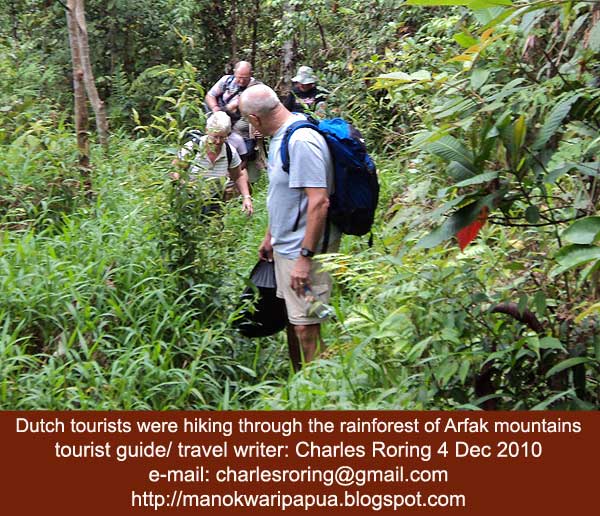
From 4 to 6 December 2010 I guided 7 Dutch and 1 Indonesian tourists to the tropical rainforest of Kwau village in Arfak mountains of Manokwari regency. Six of the Dutch were elderly people whose ages are between sixty to seventy years old. I had not known this until I met them on the 1 of December 2010. Well, I had planned a tour in the jungle whose terrain was more suitable for young age people. I felt a little bit guilty about it. I was not able to cancel the trip to Kwau village because Hans Mandacan already informed the villagers about our planned visitation.
So, on the 4 of December 2010, two 4WD cars - Toyota Hilux left Manokwari for Arfak mountains. These cars were very powerful in climbing the steep slopes of the Arfak mountains. In addition, the drivers whom I chose were the experienced ones. Along the way I was praying that these people would be able to walk through the rainforest, overcoming hills in front of them and finally arrive at Hans Mandacan's house. His house is not a luxurious rain forest resort equipped with complete facilities and fireplace cabins. It is only a simple 4-bed room house which Hans built by himself at a hill near Kwau village.
At around 13 p.m. we arrived on the road near a pathway leading to Hans' house. Around twenty villagers from Kwau village were waiting for us. They were women, men, boys and girls. They would carry our bags to Hans' house which he had changed into a temporary tourist house. We handed over our things to them and up we walked into the woods. Everything seemed to run well in the first ten minutes of the jungle walk. After that they began to ask whether the house was still far from our sight or not. We could only say that we were getting closer to the tourist house.
Birds were singing in the brances of the tropical trees. Perhaps they were enjoying the nectar of wild flowers or eating various forest fruits. December was time for fruiting season in West Papua. Birds and other rainforest animals were having parties with the abundant food that they had that month. Particularly for the magnificent birds of paradise, they like to eat red fruits. These old people were getting tired after ten minutes walking up several slopes of the Kwau village territory. It took one hour for the whole tourists to arrive in the tourist house. Besides it was far from the main road, the tourists often stopped for a while to take a rest or to see rainforest flowers, mushroom or anything that looked interesting in the jungle. When they arrived in the house, one of them complained to Sjaak (the coordinator of the tour) that the trekking route that day was too heavy for her.
So, if you plan to visit Arfak mountains, prepare yourself for a long rainforest hiking that will consume much of your energy in the slopes of the tropical rainforest. It is better to practice walking for at least three months before you go to West Papua. The duration of your walking practice can be 30 to 60 minutes. You will feel exhausted by that. Arfak mountains are rich of mammals, birds, reptiles and insect but they pose big challenges to those who want to explore their natural beauty. by Charles Roring
Also read:
Friday, December 17, 2010
Tropical rainforest Orchids
![]() |
| Orchid Flower in Arfak range |
Although orchid farming is still considered as a small home business activity. Many people still do it in front of their home yards. There are not any companies in West Papua that have opened large areas of farmland to be used for cultivating orchid flowers.
A few months ago, there was an Orchid exhibition in Manokwari city organized by the government to promote orchid as a non-timber forest or agricultural products. Papua and West Papua provinces have a number of dendrobium orchid species that are expensive in such big cities as Jakarta, Surabaya and Denpasar. The local government want to promote the region as the major supplier of this tropical flower to improve the living condition of the flower farmer.
![]() |
| Pseudo Bulb of Orchid |
If you go hiking in the tropical rainforest of Arfak mountains, Table Mountain and the North Coast of Manokwari regency, you will be able to see various species of orchid plants in the jungle. Papuan people do not see orchid only as decorative plants. They use orchid fiber to make noken (string bags). The pseudo bulbs of orchid is also used by the islanders in Numfor island as herbal remedy for abscess. The pseudo bulbs contain sticky thick liquid than can be applied on the surface of one's skin that is suffering from abscess. The liquid will suck the pus and dry the wound without causing severe pain.
![]() |
| Orchid Plant in A Tree in the Forest |
So, next time when you see an orchid plant with its beautiful flowers, you will know that it is also a good herbal medicine. From the above story, we can conclude that the preservation of the tropical rainforest is not only important for fighting global warming through the absorption of CO2 gases but also for protecting the high biodiversity that it has for the improvement of the standard living condition of mankind. From the rainforest, we can get a lot of species of plants that have medicinal functions. Rainforests and global warming are two important issues that cannot be separated but the preservation of these rich environments is not limited to them. Simply, it is very important for all of us.
On a separate trip into the rainforest of West Papua, I accompanied a young Biologist from the United Kingdom. Her name is Georgie. We went hiking through the jungle of Manokwari town. Our destination was the tropical rainforest of Dopi river on the west of the town. We saw fruit doves, pygmy parrots, Blyth's hornbills, butterflies, and various colours of terrestrial orchids. Perhaps, the one in the above photograph is Spathoglottis plicata. If you are looking for more information about orchids, try to buy some books at Amazon online store
![]() |
| Terrestrial Orchid |
Flower Tour in the Minahasa Highlands: From Tomohon to Tincep Village in Subdistrict Sonder
The Minahasa Highlands of North Sulawesi are among Indonesia’s most enchanting destinations — a region of cool mountain air, fertile volcanic soil, and landscapes painted with color. At the heart of this natural beauty lies a journey that every nature lover should experience: the **flower tour from Tomohon to Tincep Village in Sonder Subdistrict**. This route captures the essence of Minahasa’s floral richness, rural charm, and cultural warmth, offering visitors a vivid glimpse into a land where flowers bloom year-round.
![]() |
| Waterfall, flower garden, birds and butterfly in Minahasa highland |
1. Tomohon – The City of Flowers
Your flower journey begins in Tomohon, famously known as the “Kota Bunga” or “City of Flowers.” Nestled between Mount Lokon and Mount Mahawu, Tomohon enjoys a cool, misty climate — perfect for cultivating a stunning variety of flowers. As soon as you enter the city, you’re greeted by rows of colorful flower stalls and gardens that stretch across the hillsides.
One of the main attractions here is the **Tomohon Flower Gardens**, where local farmers and florists proudly display their blooms. The market bursts with colors — bright chrysanthemums, elegant roses, cheerful daisies, and exotic orchids. You can watch locals crafting beautiful arrangements or even purchase fresh bouquets directly from the growers.
Another highlight is the **Tomohon Flower Festival (TFF)**, held annually around August. During the festival, the city transforms into a floral paradise with floats, parades, and flower-themed exhibitions, showcasing the creativity and horticultural skills of the Minahasan people.
For those who prefer a more tranquil experience, visit **Kebun Raya Tomohon (Tomohon Botanical Garden)**. This expansive garden sits on the slopes of Mount Lokon and features native plants and flower species from across Sulawesi. Strolling along its paths, you’ll find rare orchids, begonias, and other tropical blooms set against panoramic views of the highlands.
2. The Scenic Route from Tomohon to Sonder
Leaving Tomohon, the road to **Sonder Subdistrict** winds through picturesque countryside dotted with traditional wooden houses. The journey, roughly 15 kilometers, offers magnificent views of the Minahasa Highlands — terraced fields, volcanic peaks, and flower farms that seem to merge seamlessly into the landscape.
Along the way, you’ll pass through small farming communities such as Rurukan and Tombariri, where flowers are cultivated not just for sale but as part of daily life. Villagers often plant bright marigolds, bougainvilleas, and zinnias around their homes, giving the entire journey a colorful, festive feel.
As you descend toward Sonder, you’ll notice an increase in the number of flower gardens and nurseries. Many of these are small family-owned farms that grow flowers for local markets, religious ceremonies, and special events throughout North Sulawesi. Visitors are often welcome to stop, take photos, and even purchase freshly cut flowers directly from the farmers.
![]() |
| Flowers that are offered for sale |
3. Tincep Village – The Heart of Rural Floral Beauty
Your final destination, **Tincep Village**, is one of the most charming villages in the **Sonder Subdistrict**. Known for its fertile soil, Tincep has long been a center of agriculture — producing not only vegetables and spices but also an impressive variety of flowers. The village sits in a lush valley surrounded by hills, with a cool breeze and constant fragrance of blooming flora.
The villagers of Tincep take pride in their flower gardens, which are often small but vibrant. Here, you’ll find roses, celosia, chrysanthemums, dahlias, sunflowers, bougainvillea, flourishing side by side. The simplicity of these rural flower farms contrasts beautifully with the grandeur of Tomohon’s larger gardens, offering visitors a peaceful and authentic countryside experience.
Many locals in Tincep are happy to invite visitors into their gardens. You can learn how flowers are cultivated, cared for, and harvested — often using traditional methods passed down through generations. Some residents even offer garden tour, allowing you to see closely how they tend various flower plants at their front, side and back yards.
In addition to flowers, Tincep is also known for its **organic farming practices** and **community-based tourism** initiatives. Visitors can take guided walks around the village, enjoy traditional Minahasan dishes like *Tinutuan* (vegetable porridge) and *Ikan Woku* (spicy fish stew), or relax in small homestays surrounded by nature.
![]() |
| Tropical flowers at the frontyard of the villagers' houses in Minahasa highland |
4. The Culture and Charm of Sonder
While the flowers are the main attraction, the wider **Sonder Subdistrict** has its own unique appeal. The people of Sonder are known for their friendliness and hospitality. Local traditions are still alive — from **Minahasan wooden house craftsmanship** to **traditional dances and music** that often accompany village celebrations.
If you visit on a Sunday, you might hear church bells ringing across the hills — a reflection of the community’s deep-rooted Christian faith, harmoniously coexisting with their respect for nature. The villages in Sonder are also famous for their clean, well-maintained surroundings, often adorned with ornamental plants and flowering shrubs that brighten every corner.
5. Best Time to Visit
The Minahasa Highlands enjoy a mild climate throughout the year. During April to November, the skies are often clear, and most flowers are in full bloom. If you visit in August, you might also catch the **Tomohon Flower Festival**, making your trip even more memorable.
6. Travel Tips
- Flight Routes: Visitors who are interested in taking this flower tour need to fly to Manado city which is the capital of North Sulawesi Province, Indonesia. International Direct flight is available between Singapore and Manado city served by Scoot Air. Another route is from Guangzhou and Manado city served by China Southern Airlines and TransNusa. For domestic flights, there are regular daily flights between Manado and major cities in Indonesia such as Jakarta, Surabaya, Denpasar, Makassar, Balikpapan and Sorong city.
![]() |
| Flying to Manado city |
- Getting There: Tomohon is about 45 minutes from Manado by car. From Tomohon, the drive to Tincep Village in Sonder takes approximately 30–40 minutes. You can rent a car or motorbike, or hire a local guide to explore the area.
- Accommodation: Tomohon has various hotels, guesthouses, and eco-lodges. For a more authentic experience, consider staying overnight in a **village homestay** in Tincep or Sonder.
What to Bring: Comfortable walking shoes, a hat, a light jacket (as the weather can get cool), and a camera to capture the scenic landscapes.
Respect Local Customs: Always ask for permission before entering private flower gardens, and support local farmers by buying their flowers or handmade souvenirs.
7. A Journey of Color and Calm
The flower tour from **Tomohon to Tincep Village** is more than a scenic drive — it’s an immersion into the heart of Minahasa’s natural beauty and local life. From the bustling flower markets of Tomohon to the peaceful gardens of Tincep, the journey reveals how deeply flowers are woven into the region’s culture and identity.
Here, every bloom tells a story — of volcanic soil that nourishes life, of mountain breezes that carry the scent of nature, and of people whose love for flowers has turned the Minahasa Highlands into a living garden.
Whether you’re a photographer, a flower enthusiast, or simply someone seeking tranquility, a flower tour through **Tomohon and Sonder** will leave you refreshed, inspired, and enchanted by the endless colors of North Sulawesi’s highlands. 🌸
Booking
The duration of this tour is as short as 1 day to as long as 3 days to see most of the flower varieties that local farmers grow. This tour can be combined with sightseeing tour in Minahasa highland as well as birdwatching and butterfly watching in Mount Mahawu, Mount Lengkoan of Minahasa highland, The outskirts of Manado city and Tangkoko Nature Reserve.
To book your tour, please, contact: Charles Roring by email to: peace4wp@gmail.com
Also read:
Labels:
Flowers,
Global Warming,
orchids,
Tropical rainforest
Subscribe to:
Posts (Atom)