Experience the beauty of tropical rainforest - Situated in the north of Manokwari, Table Mountain has been a good recreational place for city dwellers and tourists who love to go hiking and see the nature of Papuan tropical rainforest. Hiking is the best way to discover the secret beauty of the “green jewel” of the equator.
My trip to the Gunung Meja starts in the morning from Losmen KAGUM, a small hostel located at the foot of the Table Mountain. Usually, I and some tourists leave for the Table Mountain at 9 a.m.
We will walk along the road that goes to SD Negeri 1 elementary school (formerly known as Klim en Daal during the Dutch period) before entering pathway leading to the Top of Table Mountain.
As we ascend the slope of the mountain, we will see Jati and Eucalyptus Deglupta trees which were planted by the Dutch. Entering the tip of the forest, we will begin to feel a sudden change in air temperature. Under the canopy of the tropical trees, it is cool and fresh. Various kinds of palm trees and other vegetations thrive healthily.
For energetic travelers, the pathway leading to the top of the Table Mountain is a good warming-up trail that stimulates their body to enable them breath more clean air that is good for their health.
The singing of birds and the sound of insects is the best natural music that brings peace and calm in the mind of every nature lovers.
The Table Mountain of Manokwari in West Papua which shelters the primary forest in the middle of the city is a protected botanical park which also serves to educate every body on the variety and abundance of Papuan flora and fauna.
Mushroom
The ground condition of the tropical rainforest of the Table Mountain is wet, humid and full of moisture. It is an ideal growing place for mushroom. During the rainy season, we can find a lot of species of mushrooms emerging from the top soil, decaying leaves and woods. They are rich of organic nutrients that mushrooms need to sustain their growth. Although mushroom can be found all year round in this forest, the best time to see the mushroom in Papua is during the rainy season which usually begins from December and ends around May. Don’t forget to bring your raincoat if you want to explore the beauty of these soft plants during those months.
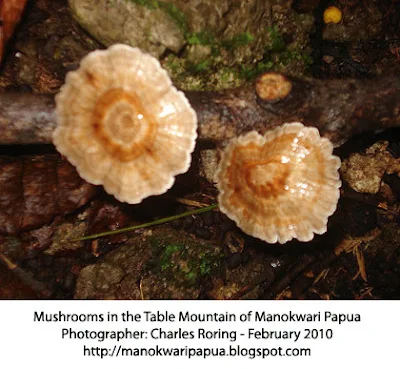
Under the giant trees, the ground receives very little sunlight, mushrooms bloom like other ordinary flowers early in the morning. Some of them even have forms that are similar to coral reef. Green grass and other vegetations cover the ground surface of the Table Mountain keeping the ideal humidity for the mushrooms. Some of them are edible, some have medicinal functions. Most of the edible tropical mushrooms do not have pungent taste as the European truffle do. But they are high in fiber and contain vitamins that are good for our health. If you are interested in eating mushrooms in Manokwari, I advise that you buy them at traditional markets in Sanggeng and Wosi areas of the city. The indigenous Papuan know the ones that are edible and the ones that are not.
Although the Table Mountain is located near the Manokwari city, it is still rich of green plants, thanks to the tougher stand from the local government in keeping it as a protected forest. When we walk at night, we will find some macro and micro fungi that glow in the dark.
The deeper we walk into the jungle, the more we discover its beauty. The Table Mountain of Manokwari has several natural caves which are homes to unique lizards, and night animals such as bats. These animals sleep during the days hanging on the crystal walls of the caves and flying out to find food at nights.
Exploring the Caves
Escorted by our experienced forest guides, we will be able to see these exotic animals and take some pictures of their dwelling places. Make sure to bring torch to help you navigate inside the caves.
As we walk deeper into the cave, we have to keep silent to let the bats sleep soundly and peacefully. Take the pictures of the animals from safe distance and use the zoom feature of your digital photo or video camera to have a closer look of the bats. If you approach too close to them, bats will be afraid and fly away.
To have better quality photographs or video recordings, check your camera whether it has been set for night or dark shooting. If you don’t know how to set it on your equipment, read the manual book or ask someone who knows how to use such equipment.
The walls and the ground surface of the caves are wet, and slippery. Move slowly and carefully as you explore deeper into the interior of the cave. Respect the animals that live in the cave. Never catch the bats or the lizards as you are only a guest and they are the real host of the cave.

Bird Watching
Bird watching is a favorite activity which tourists like to do when wandering inside the rainforest of Table Mountain. The perfect time to do bird watching is during sunny days, in the morning and in the afternoon.
The sounds of birds singing and dancing on the branches of the trees are beautiful natural music that is powerful in relieving our mind from workload stress which we usually experience in the city.
Birds usually gather at certain trees that are fruiting. Walk slowly and avoid being seen by them. Hornbill like to eat fruits in a group of six to ten, sometimes more. When flying the waving of their wings sounds like a tornado in a calm forest.
Use long-distant lenses in your digital photo camera to shoot birds at high trees. In the afternoon before the sunset, big birds such as palm or giant cockatoo will fly back to their nests which are holes in tall and big trees. Before resting in their nests they will sing and play with their friends for a while. This is the perfect time for bird watchers to see them. With the help of our experienced forest guides, bird lovers will be able to see various species of Papuan birds in the Table Mountain of Manokwari. Bird watching in the Table Mountain is a prelude for a more challenging adventure which many tourists can experience when they take hiking tours in Arfak Mountains located on the opposite site of the Dorey bay.
Insect Watching
When we walk through the tropical rainforest, we will see various insects from the ground up to the leaves of branches and twigs of trees.
Tourists from outside of Papua should apply mosquitoes repellent lotion on the skin of their hands, neck, and other open areas both in the body and legs.
Insects are an integrated component of tropical rainforest ecosystem. You might have watched on television that bees and butterflies play very important role in the pollination of plants. This also applies to wild flowers in the forest.
Spiders patiently build their net to catch other small insects flying around.
When doing insect watching, be careful not to be bitten by ants or be stung by bees. Insects are small and fragile, make sure that you will not hurt them.
If during an observation you see an insect is being threatened by its predators, please do not interfere as it is the natural occurrence that always happen everyday inside the rainforest.
What tourists must do is to minimize the impact of their presence inside the forest.
For observing small insects, you may need a loop to enlarge their visual appearance. Photographing small insects from closer distance needs special technique. If your digital camera has been set to auto-focus, you will be able to shoot pictures which will result in good quality photographs. But if you have known your device well, you can set it to macro view that is more suitable to shoot objects like small insects in closer distance.
Humidity is very high in tropical rainforest. Only around 5 percent of sunlight reaches the ground. This makes it an ideal place for insects to live. Butterflies, beetles, grasshoppers and mosquitoes, can easily be found among green vegetations in the Table Mountain of Manokwari. Collecting insects for research purposes in the tropical rainforest is not recommended except if you are a professional entomologist. This is written by Charles Roring


