Showing posts with label cuscus possum. Show all posts

Monday, February 10, 2020

Watching Papuan Pitta, Cuscus Possum and Insects in Susnguakti Forest

Red-bellied Pitta (Erythropitta maklotii)
The Papuan Pitta (Erythropitta maklotii)
I went to Susnguakti forest in the suburb of Manokwari a few days ago. I guided 2 tourists (Andrew and Barbara) from Poland. We spent our time in the forest to enjoy hiking, birdwatching, insect watching, and general wildlife watching. We explored the rainforest of Susnguakti in the mornings, afternoons and in the evenings. 

Watching Paradise Birds

Because they were veterinarians, they were familiar with biological terms of animals and plants. Some of the birds that we saw and heard during our tour in this eastern region of Arfak range were Lesser Birds of Paradise, King Bird of Paradise, Magnificent Riflebird, Common Paradise Kingfisher, Yellow-billed Kingfisher, Rufous-bellied Kookaburra, Hooked-billed Kingfisher, Frilled Monarch, Golden Cuckooshrike, Hooded Butcherbird, Northern Variable Pitohui, Pink-spotted Fruit Dove, Amboina Cuckoo Dove, Black Sunbird, Fairy Lorikeet, Sulphur-crested Cockatoo, Eclectus Parrot, Black-capped Lory, Blyth's Hornbill and etc.
Birdwatching and Rainforest Tour in Manokwari
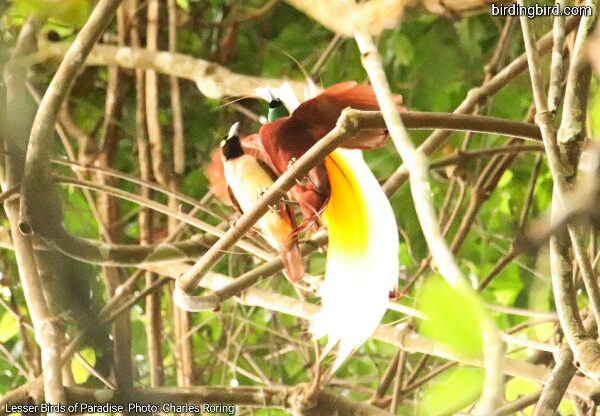
A Couple of Lesser Birds of Paradise in Susnguakti forest in the morning

Watching Insects

Night walk was our favorite activities. We did it every night. Because we regularly clear the walking paths in the jungle by cutting tall grass and sweeping the fallen leaves and twigs using palm brooms. This gives an easy access for visitors to explore most parts of Susnguakti forest. Stick insects, assasin bug, longhorn beetle, crickets, fire flies praying mantis, snout beetle, spiders on the leaves of plants, moths, butterflies, trunks of trees and on the ground. Our Polish guests said that Susnguakti was a very nice forest. 
Night walk tour in Susnguakti forest with 2 Polish tourists
Cicada in Susnguakti forest of Manokwari

Calling Cuscus Possum

A villager who accompanied us had a special skill to call cuscus possum. It was around 08.45 when we left our base-camp on the second night of our tour in Susnguakti. We stopped for a while at a slope leading to the birding ground for King Bird of Paradise. Moon provided twilight for us. Usually when there is moon in the sky, our chance to see cuscus possum is low. However, this time, it was different. Our Papuan friend began to immitate the sounds of female cuscus. In less than 5 minutes, we could hear the sounds two possums. The sounds of broken twigs in trees were heard when they were walking towards the "female cuscus." Suddenly we heard fightings above our heads. Seconds later a small cuscus possum fell to the ground with a thud. Our Papuan friend turned on his torch and jumped to the possum. He chased the possum. I warned him not to catch the cuscus because it had sharp claws. He grabbed its tail and brought the cuscus possum closer to us.
Night walk tour in rainforest
The cuscus possum that fell on the the ground
For us, the skill of immitating the sounds of cuscus to attract the marsupial animal at night was an extraordinary skill. But this time, he caught it using his bear hands. We were able to see and make good photographs of the cuscus.
We continued our night walk exploration to higher elevation area of the forest. We saw more insects including moths, longhorn beetle, and cicada. We also saw a Papuan Pitta too. He was sitting on the branch of a small tree. We carefully approached the bird and made some pictures of the bird. It did not fly away. We also saw wild flowers on the forest floor. Some emitted fragrant scents. Unfortunately, we do not have the capital to refine the flowers for making essential oils.
rainforest tour in Manokwari
Wild Flowers in Forest Floors
It was a nice adventure that night. When we returned to our basecamp again we felt very happy. We were able to see interesting animals.
Susnguakti is a lower montane forest of Arfak mountains. It has been visited by tourists from all continents of the world since 2011. The first tourists who went to Susnguakti forest were university students from Poland. I organized their trip.
Two tourists from Poland with Charles Roring and his team
Our team with 2 Polish tourists in Susnguakti forest

To reach Susnguakti forest, tour participants have to be physically fit. From the place where car stops, visitors need to go hiking up steep slopes for 1 hour to reach our basecamp. It is a very basic accommodation. We provide mattrass, dome tents, cooking and eating utensils. 
Visitors need to bring clothing that is suitable for hiking, trekking boots or sport shoes, and tropical rainforest, insect repellent lotion, torch/ flash light, and camera with extra batteries. This trip is only suitable for rainforest enthusiasts. 
If you are interested in traveling to Manokwari city to enjoy birdwatching, insect watching as well as wildlife watching in general in Susnguakti forest, you could contact me (Charles Roring) to organize your trip. This is my cell phone/ whatsapp number: +6281332245180.

Please, support this blog by buying some artworks that are available as t-shirts, mugs, cell phone case, stationery, home decor and etc. at the following links:

Thursday, November 14, 2019

Birding in Susnguakti Forest with 2 French Tourists

I have just returned from Susnguakti forest this afternoon. I and some local villagers guided two French tourists on a 4 day/ 3 night hiking, camping, bird and wildlife tour. They were Geoffrey and Jessica. Susnguakti forest is a lower montane forest in the south of Manokwari city. We went hiking in the mornings and in the afternoons to find birds of paradise. They were able to watch Lesser Birds of Paradise, King Bird of Paradise, and Magnificent Riflebird.
Hiking, camping in Manokwari
Lesser Birds of Paradise (Paradisaea minor)

Thursday, August 16, 2018

Hiking and Camping in Susnguakti Forest of Arfak Mountains

Dutch students camping in Susnguakti forest
Guest Post by Eline
We went with Charles to the Manokwari jungle hills in the summer of 2018. All in all it was an amazing experience that I would recommend to any nature lover. In the end of the afternoon we left from Manokwari. Charles, who is fluent in English and Indonesian, took us to a local market first to buy our food for in the jungle. Afterwards, we spent about 1 hour in the car on a road along the coastline. In the middle of nowhere you get out and take off. Don't expect a grant-maintained path, signs or other people. From the coastal road you just have a 1-hour, steep climb up straight into the jungle hills. This climb often involves pulling yourself up by your hands and can be a bit thrilling. Not to the locals though, they guide you barefoot effortlessly. When we arrived at the base camp in the midst of the jungle, some wooden platforms with tents awaited us. No shower, toilet or beds. Instead a little stream, some tarantula's and the most beautiful sound of hundreds of animals. Together with some locals, Charles prepares a nice meal on a camp-fire.
Afterwards, a night-hike is scheduled. After holding our breath and sitting in the dark for 20 minutes three times, our patience was rewarded. One of the local guides had lured a Koeskoes Oppossum (Australian marsupial) straight to our location. Furthermore we saw lizards, birds, many big spiders, frogs and many more animals. Be prepared to get very dirty and walk through many spider webs. Part of the experience! In the morning we went to look for the famous Birds of Paradise, which was an amazing experience. The local guides know how to get you really close to the birds and have an amazing eye for spotting them. After a good lunch we went back to civilization. Seeing the jungle in sunlight was amazing and the trip resulted in many beautiful pictures and even more unforgettable memories. A must-do for anyone who is not scared to go back to basic and Charles become one of the best friends we made in West-Papua

Tuesday, October 18, 2016

Birdwatching in Lower Montane Forest of Arfak Range

Lower Montane Forest of
Arfak Mountains
in Warmarway village
Arfak range has been famous as birdwatching destination in West Papua. Most visitors go there to watch birds of paradise. There is a village called Warmarway in the eastern region of Arfak. It is a recommended area for visitors who want to watch such birds as Lesser Birds of Paradise (Paradisaea minor), Sulphur Crested Cockatoo (Cacatua galerita), Papuan Hornbill (Rhyticeros plicatus), Pinon Imperial Pigeon (Ducula pinon), Palm Cockatoo (Probosciger aterrimus), and a lot of other birds which I cannot mention one by one.
Local villager Yunus Sayori could guide visitors in the jungle and stay in a camp for several days to watch birds and other wild animals.
Male Lesser Birds of Paradise
He has got special skill in immitating the sound of female cuscus possum to attract the male possum during night walk. When he calls, all torches have to be off. When the cuscus possum has come, he will tell every visitor to turn on the light and take pictures of the possum.
On the average, visitors stay for 3 to 6 days in the jungle. Most of them are interested in everyrhing rainforest.
Itinerary
Day 1
Arrive in Manokwari city
Getting Surat Jalan from local police station
Buying food, bottled water and other goods needed for the trip in traditional market and supermarket.
Transfer to Warmarway village at the foot of Arfak mountains
Walking up steep slopes into the jungle.
Setting up tents
Birding and wildlife watching around the campsite area
Overnight stay in the tent in the jungle

Cuscus Possum
Day 2
Wake up early in the morning at 05.00, have some tea or coffee.
We will leave for the display tree of Lesser Birds of Paradise
We will watch the birds until around 09.00 and then return to basecsmp.
After breakfast will walk up the slopes to explore the forest for its insects, birds, reptiles and other wild animals.

Day 3
We may build tents in higher elevation forest to explore the jungle. We can do night walk to find Papuan frogmouth.

Day 4
We can walk down to our first camp again to take arest before going back to the village to explore its lowland forest. There are orchids, unique glowing mushroom as well as colorful insects.

Day 5
Walking down the jungle and explore the lowland forest. Built tent near the river. Birding and wildlife watching.

Day 6
Walking back to the main road and return to the city.

For price, please, contact me (Charles Roring) by email: peace4wp@gmail.com.

Related Post:
Rainforest Tour in Arfak Mountains near Warmarway Village

Tuesday, June 16, 2015

Night Hiking in the Jungle of Arfak mountains

Two days ago I guided two Spanish tourists (Expedito and Maria) on 1 night/ 1 day hiking tour in the forest of Arfak mountains. We left Manokwari city by car at 21.30 for the jungle of Arfak mountains in the territory of Warmarway village. When we arrived in the village, my smartphone clock showed 22.30 so I offered an overnight stay in our guesthouse that was being built at the beach. They said that they preferred to stay in the jungle. Maria wanted to see cuscus possum. So, we continued our trip to the stop point where we would go hiking in the jungle. Night hiking was more dangerous because the slopes were very steep. We walked slowly. I held my battery powerd LED lamp higher to give light to all of us. Each of us carried heavy bag on our back.
After passing the steep slope, we stopped for a while. Yunus, the villager from Warmarway village, who guided us in the jungle would try to call Cuscus Possum. All of the flash lights and my LED lamp had to be turned off. Yunus began to imitate the sound of female cuscus to attract the male one. We sat on the ground for approximately fifteen minutes waiting for the cuscus to come. He did not come.
Cuscus possum in the jungle of Arfak mountains of Manokwari
I told Yunus to continue walking again. We stood, turned on the flashlight, pick up our bags and then continued our night hiking again. It was getting late. The dark forest around us was full with the sounds of insects. They became our natural music that sooth our minds. So relaxing music. We made the second stop in the jungle and turned our lights again. Yunus made his second call imitating the sound of femail cuscus. The jungle was very dark but we could still see some light at tree tops. The light from starry nights. After calling for 10 minutes, we began to hear the sounds of braking twigs and the movement of tree branches. The sounds were getting closer above our heads. Suddenly, Yunus asked me to turned my lamp on. I did it and there it was - the cuscus possum in the branch of a tree. I opened my waist bag and took my camera out of it. It was a Fujifilm HS50EXR. I aimed it at the cuscus and made several pictures. Maria, one of the tourists, looked very exited to see the cuscus. She turned on her camera and took some pictures of the cuscus. Then we walked again deeper into the jungle.
Yunus still made another call but no cuscus came. We finally arrived in our base camp. We boiled water and had some hot chocolate drinks. We went to bed at 02.20. All of us were happy with the night hiking trip that we had just done. written by Charles Roring

If you are interested in visiting Arfak mountains to see butterflies, cuscus and the forest environment and need me as your guide, please, contact me by email to: peace4wp@gmail.com.

Thursday, September 11, 2014

Rainforest Tour in Arfak Mountains near Warmarway Village

Steep road near Warmarway village
Arfak mountains have been a favorite destination for tourists who want to see and experience everything about rainforest. There is a coastal village in the easternside of the mountains that frequently receives tourists. Its name is Warmarway. Visitors can take a public transportation from Terminal Wosi in Manokwari city to the village.

Cuscus Possum in the jungle of Arfak mountains
Trekking and Wildlife Watching
Guided by local villagers, visitors can start walking up steep slopes of lower montane forest to a basecamp deep in the jungle. Lesser Birds of Paradise, Sulphur Crested Cockatoo, Blyth's hornbill, Papuan frogmouth, Black capped lory live in the lower montane forest of the range.
Local villagers have gota special skill in calling cuscus possum. This nocturnal animal goes out to find food at night. He will imitate the sounds of female cuscus to attract the male one.
When I went trekking with some tourists from Belgium and The UK, I saw petals of ylang-ylang or cananga flowers on the ground. The flowers are important raw materials for making essential oil. Other tropical vegetation include terminalia cattapa, iron wood trees, bamboo trees and mushrooms that glow at night.


Locations of Mupi Gunung and Warmarway
in the eastern region of Arfak mountains
How to go to Manokwari?
  • From your country, take an international flight to the capital of Indonesia - Jakarta city
  • After that you can continue your trip by taking a domestic flight to Manokwari city (the capital of West Papua province). Domestic airlines that fly to Manokwari city are Garuda Indonesia, Express Air, Wings Air, and Sriwijaya Air.
  • I could meet you at the airport and organize your rainforest tour in jungle of Arfak mountains.
Booking
Please, contact me by email to: peace4wp@gmail.com or by sending text message to my cell phone: +6281332245180.