Showing posts with label trekking. Show all posts

Saturday, October 29, 2016

Wildlife Watching in the Rainforest of Arfak Mountains

Spanish tourist in Arfak mountains
Rainforest tour in Manokwari
Arfak mountains have been an important destination for visitors who want to see wild animals of New Guinea. Most tourists who go to Arfak mountains are birdwatchers. Their main goal is to watch birds of paradise.
As a matter of fact, the are other animals which tourists can see while walking in the jungle. Some of them include soa-soa lizards, wild pigs, snakes, frogs, birdwing butterflies, cuscus possum, tree kangaroo, and bandicoot. Insects have also been the focus of attention of some scientists who travel to Arfak mountains.
Georgina Darroch was holding a frog
Rainforest tour in Manokwari
Trekking and Camping
The best way to explore the bio-diversity of the rainforest environment of Arfak range is by camping in the jungle and do the exploratory walks during the days and nights. The chance to see wild animals is higher if we stay in the jungle and explore deeper forest area. As a tourist guide, I have accompanied a lot of visitors on trekking and camping trips in the forest. They usually stay between 3 to 5 days.

Hiking in Susnguakti forest
Susnguakti forest Forest of Arfak Mountains
I highly recommend Susnguakti forest because it is still in pristine condition. Here, visitors can watch Lesser Birds of Paradise in the morning, explore trees, shrubs, lianas and mushrooms during the day and do night walk to find cuscus possum and Papuan frogmouth bird at night
Itinerary
Here is a typical itinerary for visitors who want to go trekking and wildlife watching in Arfak mountains:
Day 1
Arrive in Manokwari
Getting Travel Permit (Surat Jalan) from local police station
Transfer to Arfak mountains
Overnight stay in the jungle tent

Day 2
Wake up early in the morning at around 4.30
Drink tea, or coffee. Leave the camp at approx. 05.00 for the display trees of Lesser Birds of Paradise (Paradisaea minor). Watch birds until 09.00.
Return to base camp. Have breakfast. Take a rest.
At 11.00, we can do the exploratory jungle walk to see tropical trees, bamboo, lianas, wild flower plants on the ground and orchids in high trees.
We can return to our camp again during the day or continue our trekking tour deeper and higher into the mountains.

Day 3
We can walk down the forest and continue exploring the forest in the lowland area of Arfak mountains.
We can built tents by a small river and do jungle walk during the day and at night.
Overnight stay in the jungle.

Day 4
We can dismantle our tents and walk back to the main road and return to Manokwari city by car.

Arfak mountains
Lake Anggi Gida
Price: please, contact me by email
The cost includes transportation between Manokwari city and the entrance point at the foot of Arfak mountains, food in the jungle, local guides.
The cost does not include airfare, travel insurance and hotel accommodation in Manokwari city. I can help you book a room in a hotel in this city.

How to go there?
  • Fly from your country to Jakarta, the capital of Indonesia.
  • Continue your trip to Manokwari city by a domestic airline such as Batik, SuperAirjet, Lion Air.
  • I can meet you at the airport or at the hotel where you stay and arrange your trip to the mountains.

traditional house of Sougb tribe
Traditional house of Sougb tribe in Arfak range
Customized Itinerary
I could organize a trip for you to Anggi lakes where you could see the villages that exist around the lakes, beautiful flowers, also meet and stay with the indigenous people in their traditional house.
Booking
Please, use the contact form in the top right side of this blog or send your email directly to my email: peace4wp@gmail.com


Tuesday, September 6, 2016

Trekking and Watching Birds in Imubri Forest of Arfak Range

Arfak range is a very popular birdwatching site in the world. Thousands of tourists have visited it since tens of years ago. There is a new wildlife/ birdwatching site in Arfak range that I am now introducing to all rainforest lovers or birdwatchers. Its name is Imubri. It is located in the south of Manokwari around one hour ride from the city. Most of the birdwatching activities are conducted along steep slopes of the mountains from lower to middle elevation montane forest. A few days ago, I guided two tourists from the UK and Portugal. We went there to watch birds, butterflies and see various species of unique trees, creeping plants and shrubs.
Birdwatching
During the trip, we were able to watch Lesser Birds of Paradise (Paradisaea minor), Moluccan King Parrot (Alisterus amboinensis), Papuan hornbill (Rhyticeros plicatus), Grey Crow (Corvus tristis), Sulphur Crested Cockatoo (Cacatua galerita). There are also other birds that we could not identify because they were too far from us and I did not use binoculars to magnify their images. We heard the sound of Magnificent Riflebird (Ptiloris magnificus). Unfortunately, we were not able to find the bird.
In addition to birds, the jungle of Imubri is also the natural habitat of tree kangaroo, and cuscus possum.
Trekking
The rainforest of Imubri is now open to tourists who are interested in rainforest, wild animals of New Guinea and birds. Those who want to go there have to be physically fit. The forest consists of very steep slopes and deep ravines.  Visitors need to wear durable trekking shoes. We often walk along the ridge of the mountains, and climb steep slopes of the mountains with elevation up to 75 or even 80 degrees. In this case, visitors are highly advised to walk slowly and carefully.

What you need to bring
  • Portable folding/ dome tent
  • Sleeping bag
  • Mosquito net
  • Biscuits, water and other kind of ready prepared food
  • Binoculars
  • Camera with superzoom lens such as Nikon Coolpix P900 or other D-SLR camera with telephoto lens
  • Insect repellent lotion
If you are interested in trekking in Imumbri forest of Arfak range of Manokwari, and need me as your guide, please, contact me by cell phone/ whatsapp to +6281332245180 or email to: peace4wp@gmail.com

Sunday, July 10, 2016

Trekking and Watching Tree Kangaroo in Arfak Mountains of Manokwari

I used to guide a visitor named Tia on a trekking tour to Imubri area of Arfak mountains of Manokwari. We went trekking in the jungle for a few days. Our goal was to see tree kangaroo but we were also interested in seeing tropical trees, shrubs, vines, wild flowers as well as birds, insects, mammals and marsupial animals.
We started our tour early in the morning. Accompanied by local people, we began walking into dense forest of Arfak mountains. At first, the path was only flat. After 30 minutes of walking, the path was leading us to steep slopes. Our walking speed was getting slower as the slopes were getting steeper.

Blyth's Hornbills
After walking for one hour we reached a flat ground again. It was almost eight o'clock in the morning but the surrounding area looked darker. Only very little sunlight that could penetrate through the canopy of the forest. Suddenly, I heard sounds of big birds flapping their wings in the branches of the tree in front of us. Several Blyth's hornbills, perhaps after hearing noise from our voices, jumped from the tree and began flying away. They looked awesome while flying. I had not finished admiring the beautiful birds when I saw another attraction on the ground. There were some pink wild flowers that were coming out of green plants. I could not identify its species name. There were also butterflies that were flying in the air. We might have disturbed them from daily routines of collecting nectar from the flowers.

deep ravine in Arfak range of Manokwari
We walked up and down numerous steep slopes and crossed small and big rivers. In the middle of the day, we stopped at the side of a fast flowing river to have lunch.  It was the last river that we would cross. After lunch, we climbed very steep slopes again until we reached our base-camp located very deep in tropical rainforest of Imubri. It took around 7 hours of walking up and down steep slopes, for us to reach our destination. 

Tree Kangaroo in Arfak range
Tree Kangaroo
We still had some walking tours in the jungle to watch birds of paradise, butterflies and most importantly the tree kangaroos. The indigenous people were very smart in locating where the kangaroos were. They used dogs. Dogs that were trained to hunt animals in the jungle could sense the smell of tree kangaroos even though  the animals were sitting in the branches of high trees. When the dog found a tree kangaroo, we could see scratches of claw prints on the trunk of the tree.
Taking pictures of the kangaroo was quite difficult. I had to adjust my camera several times and aimed it at the marsupial animal located high above my head. After several attempts, I could make some nice photographs of the tree kangaroo (Dendrolagus ursinus). It was eating young leaves. He saw us on the ground but did not move away from us. Perhaps he was curious about what we were doing down there.
Lesser Birds of Paradise (Paradisaea minor)
We were very happy with the trekking tour in Imubri area of Arfak mountains because we could see tree kangaroo in their natural habitat. We did not see flame bowerbird but it was ok. Overall the trip to watch wild animals was tough or quite difficult as we had predicted it before. But we were satisfied with the experience. It was an adventure.
Birds of Paradise
The jungle of Arfak range is the natural habitat of various animals including several species of birds of paradise. Visitors need to bring binoculars if they want to watch the birds.

Where is Arfak range?
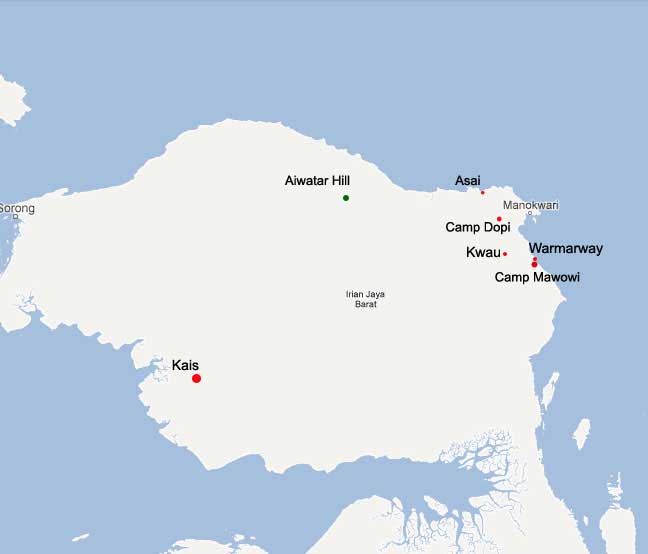
It is a mountaineous region in Manokwari, the capital of Papua Barat province of Indonesia. See the map below:

How to go there?
  • Fly from your country to Jakarta city (the capital of Indonesia)
  • Fly from Jakarta to Manokwari (there are regular flights served by  Garuda, Express Air, Sriwijaya Air)
  • I will meet you at the airport, or at the hotel where you stay and organize your tour to Arfak mountains
Are you interested?
Since 1800s Arfak has been a famous destination among foreign visitors. In the past, they came as researchers who wanted to study anything about New Guinea, its people, its flora and fauna and its land. Now most of the visitors are tourists. Only very few tourists would like to do long hours of walk to the jungle where tree kangaroes live.
Well, if you are interested, please, contact me (Charles Roring) by email to: peace4wp@gmail.com. Don't forget to do regular exercise before taking the rainforest tour with me.

Saturday, October 24, 2015

Trekking and Camping at the Banks of Syuan River

I have just returned from organizing a 4-day/ 3-night trekking and camping tour along the sides of Syuan river. I, together with local people, guided three American and one Hongkong visitors. We went to Tambrauw regency in the northern coast of West Papua. There, we explored the tropical rainforest along both sides of Syuan river.
Hiking in the jungle of Tambrauw regency
We walked on the trails that the indigenous people used for hunting wild animals. As we walked through the jungle, we saw big trees, butterflies and birds that were flying in the sky. We had to cross the river several times to make shortcuts.
Syuan had a lot of spots that were good for swimming. The water was crystal clear and cool. The atmosphere was filled with fresh air. While walking or sitting at the side of the river, We could hear the sounds of birds, and insects that were mixed with the sounds of flowing water. They were a nice natural music that could refresh our mind.
Tents were built by the river
There were some birds that I could easily identify. Among them were blyth's hornbill, sulphur crested cockatoo, and egret. There was one species whose bill was a little bit different from the illustration that I saw on Birds of New Guinea. Its name was Grey Crow (Corvus tristis). It had pinkish face but its real bill was slender. I saw the bird flying in a group of six or eight birds when I was swimming in Syuan river. For the order of Lepidoptera, there were birdwing butterfly that I saw such as the Ornithoptera priamus.
We walked slowly along the path to enjoy the beauty of nature. We stopped several times to listen to the explanation of local villagers who accompanied us about the health benefits of certain herbs. The scenery of the forest in Tambrauw mountains, ravine and bends of the Syuan river was very beautiful. 
Book your rainforest tour to Tambrauw mountains now by contacting my email (Charles Roring): peace4wp@gmail.com

Tuesday, September 22, 2015

Itinerary for the Rainforest Tour in Tambrauw Mountains of West Papua

Camping at the bank of Syuan river
Camping site at Cuan rive
I am going to conduct a rainforest trekking and camping tour in Tambrauw mountains based on the following details:

Activities: trekking, camping, riverwalk, swimming, wildlife/ birdwatching
Reservation is still open
Group Size Limit: 4 people
Price:  ...
Itinerary
Day 1 
We will meet you in Sorong city and transfer you to Tambrauw regency by 4WD car. It takes around 4 hours by car from from Sorong city to Sausapor town. We will inform local authorities and the local police about our rainforest tour activity and then continue our trip to the stop point in the forest edge of Tambrauw mountains and 30 minutes of walking along the bank of Syuan river to reach our first base camp. The rainforest which we will explore is  located in the bird's head (vogelkop) region of West Papua. Overnight stay in the jungle tents.
camping at a river in Sansapor
Soa-soa Lizard in Tambrauw Forest
Day 2
Trekking/ jungle walk, riverwalk, night walk, wildlife and birdwatching, swimming, camping
Day 3
Trekking/ jungle walk, riverwalk, wildlife and birdwatching, swimming, camping
Day 4
We still have time to enjoy the scenery of the river and rainforest. After breakfast, we will dismantle our tents and leave the forest.
A short tour around Sausapor town and its surrounding area
Transfer to Sorong city

How to get there?
  • Fly from your country to Jakarta (the capital of Indonesia)
  • Fly from Jakarta to Sorong city. Domestic airlines such as Garuda, Sriwijaya, Express Air, and Nam Air have got regular flights to Sorong.
  • I will meet you in Sorong city and organize your trip to the rainforest.

Lowland forest of Tambrauw regency 
rainforest tourism
Rainforest along the side area of Cuan river
I highly recommend this site because very few tourists have been there. So, much of the forest areas are still unexplored. Nature lovers who go trekking in this region may see various species of herbal plants, wild flowers, giant trees, birds, marsupial and nocturnal animals.
Tambrauw regency is located between Sorong and Manokwari. To go trekking in the rainforest of Tambrauw, we need to charter a 4WD car from Sorong city. It takes approximately 4 hours from Sorong city to Sausapor town (the temporary capital of Tambrauw). After registering our names in the local police station, we can continue our trip to Cuan river where we will be able to stay for a few days in the jungle.

Wildlife
From my previous trips in this forest, we saw bandicoot, eupholus beetle, Swallowtail Blue Mountain butterfly (Papilio ulysses), Blyths hornbill (Rhyticeros plicatus), Sulphur Crested Cockatoo (Cacatua galerita), Spangled Drongo and Lesser Birds of Paradise (Paradisaea minor).
Binoculars and bridge camera such as Nikon Coolpix P900 will be useful for birdwatching and wildlife watching.
To enhance your birding experience, we will bring spotting scope, field guide book entitled, "Birds of New Guinea" written by Bruce Beehler and his friends.
We will also provide camping gear such as tents, cooking and eating utensils, and torch.

Please, book now
If you are interested in taking this rainforest tour in Tambrauw regency, please, contact me by e-mail: peace4wp@gmail.com or whatsapp: +6281332245180. I will compose an itinerary and calculate the cost of your tours that are suitable with your travel schedule.

Please, support our efforts in preserving the bio-diversity of tropical rainforest in Papua


Saturday, April 18, 2015

Recommended Trekking and Birding Sites in Arfak Mountains

Arfak range is located in the south of Manokwari city. It has been a famous destination for naturalist who wants to see the beauty of Papua's nature.
I often receive emails from tourists and researchers who want to go to Arfak mountains of Manokwari. They ask for a good trekking and birding site. From my personal experience, I highly recommend such villages as Mupi Gunung, Warmarway, and Kwau. These villages have got large rainforest areas that are suitable for anybody who is interested in exploring the biodiversity of Arfak range.
Birds of Paradise
There are tens of species of birds of paradise that visitors can see in the jungle. Some of them are western parotia, lesser birds of paradise, black sickle bill, king birds of paradise, and the magnificent birds of paradise.
Tropical birds
In addition to paradise birds, other species that can be watched include sulphur crested cockatoo, pasquet parrots, pinon imperial pigeon, blyth's hornbill, pygmy parrots, vogelkop bowerbirds and flame bowerbirds.
Marsupial Animals
West Papua and Australia are the natural habitat of various species of marsupial animals. Some that visitors can see in Arfak mountains are tree kangaroo, cuscus, and bandicoot.
Recommended Trekking Site in Bird's head region
There are several locations of trekking sites in Vogelkop or bird's head region. Some of them are as follows:

  • Aiwatar hill of District Senopi in Tambrauw mountains (whic is also the best birdwatching site I have ever seen in my life); 
  • Rainforest of Warmarway village in the eastern region of Arfak mountains,
  • Klasow valley in Sorong regency (where you can see wallaby, cuscus, birds of paradise)
  • Mupi Gunung hamlet whose trails are very steep and are only suitable for visitors who are physically fit.

Preparations
Visitors need to make certain preparations prior to their trip to Arfak range. Here are some of them:
- Bring only clothes you really need. These include some T-shirts, long trousers, underwear, running shoes or trekking boots.
- Bring mosquito net, and some insect repellent lotion.
- Extra batteries, telephoto lens for your photographic activities.
- Buy food in Manokwari city.
If you want to visit it and need my guiding service, please, contact me by email to: peace4wp@gmail.com


Saturday, June 15, 2013

Trekking in the jungle of Manokwari

Also read:
The best way to explore the wealth of tropical rainforest is by walking through it. Last week, I guided 3 French tourists on a 3-day trekking tour in the jungle of Manokwari. In the first day of the trips, we explored the lowland forest along Pami river. It was a long walk. We started at 9.30 a.m and finished at 18.30 p.m. The French tourists were tough and they were able to complete the whole journey that day. They were Anne, Stephanie and Paul. 
Some French visitors were trekking in Manokwari
Trekking in the Forest of Manokwari
They saw beautiful scenery of forest when walking through Pami river. Very few tourists had experienced this trip. The purpose of the trip was to see the complex ecosystem of the tropical rainforest. While walking, they were able to see various species of trees, butterflies and birds. The most significant bird was Blyth's hornbill that frequently flies over the canopy of the forest. 
The next day, the walking tour program was continued to higher elevation forest between 1,300 to 1,500 meters above sea level where the French tourists would watch several birds of paradise such as Western Parotia (Parotia sefilata), Magnificent Birds of Paradise (Cicinnurus Magnificus). Another unique bird that was called as the king of seduction was Vogelkop bowerbird (Amblyornis innornatus). They were able to see all of them although only had a small glance of the Magnificent one. While sitting in the blind to watch the birds, they also saw a Cinnamon fruit dove. 
A French tourist was trekking in West Papua
The last day of the trekking journey was completed after they had a long walk from the guesthouse at the foot of Mt. Soyti to Kwau village. They were thrilled by the panorama of Arfak range when walking down the steep slopes that overlooked the village. 
Arfak range has been a favorite destination among tourists who visit West Papua. Anybody who wants to book this trekking program has to be physically fit. If you are interested in trekking in the lowland and highland forests of Manokwari, please contact me (Charles Roring) by email: peace4wp@gmail.com. 

Trekking in the Minahasa Highland

The highland of Minahasa is located in North Sulawesi Province, Indonesia. It is a great destination for visitors who love nature. The best way to enjoy its natural beauty is by walking through it. As a tourist guide, I offer a trekking tour for visitors who want to see farmlands, paddy fields, waterfall, rivers, villages of Minahasa. 
The duration of the tour is around 3 days to 1 week depending on the time which the participants have. Hiking shoes, 

Thursday, March 14, 2013

Trekking in Arfak

Hundreds of nature lovers go to Arfak mountains every year. They go trekking in the jungle to watch birds of paradise or see various species of plants including Orchids and Rhododendron flowers, bamboo, palms and a lot big trees. There are several villages that tourists can visit. One of them is Warmarway. Here, visitors can swim or enjoy fishing at the beach and stay for one night at a shelter that is built for tourists.
Trekking and Birdwatching
Warmarway village is a coastal village that is located on the east of the mountain range. Lesser birds of paradise can be seen in the jungle. Warmarway village is only 1 hour ride by car or motorcycle from Manokwari city.

If you are interested in visiting Warmarway, you could go there by a mountain bike, motorcycle or car. Public transportation that goes to the village is available at Wosi market. Because lesser birds of paradise in the jungle of Warmarway usually dance in the mornings and in the afternoons before sunset, you should stay there for at least one night to watch the birds. Sleeping bag and mosquito net is needed.
Before leaving for Warmarway, don't forget to buy food at local market for you and at least 2 villagers who will accompany you as local guides.
The indigenous people are friendly. Local trekking guide Yunus Sayori and the villagers of Warmarway will welcome you with smile and do their best to serve you during your trekking tour in the slopes of Arfak mountains.
After spending one or two nights in Warmarway, you could go back to the city or continue your trip further south to Ransiki town. by Charlges Roring/ E-mail: peace4wp@gmail.com

See the map below to find where Warmarway is

Monday, December 17, 2012

Rainforest Trekking in Manokwari

by Charles Roring
The tropical rainforest in Manokwari is rich of bio-diversity. Birds, insects, reptiles, marsupials, and mammals live in the jungle of Arfak mountains. Tourists who go trekking in Arfak can watch birds of paradise, and cuscus possum which are the most popular attractions. Several species of birdwing butterflies can be found in the jungle too. There are several trekking destinations in Manokwari. Some that I recommend are the jungle of Warmarway in Arfak mountains and Mesirrokow lowland forest in northwest region of Manokwari. Use a good pair of trekking boots, and sleeping bag for exploring the jungle of Manokwari. 

A camp for tourists has been built in Warmarway. It is not easy to reach the camp. Visitors need to walk up steep slopes of Arfak mountains for approximately one hour. Cooking and eating utensils have been prepared by local people to serve the visitors. So, they don't need to bring their own cooking gear. Early in the morning when all the people in Manokwari town are still sleeping, visitors have to wake up to start their journey into the jungle to watch the lesser birds of paradise. They usually start to dance at around 5.45. Trekking route to the dancing site is quite difficult. It is steep and slippery. Visitors need to walk through several small streams of mountainous water that flow down through the granite rocks of Arfak. 
To capture the fleeting moment of the dancing birds, visitors need to bring telephoto D-SLR camera. Today, Nikon have developed super zoom digital camera that is more affordable to travelers. The latest type is the Coolpix P510. It is a telephoto device that sports 42x optical zoom, equivalent to 1,000 mm in 35 mm lens format. Canon also has manufactured a bridge camera with specifications that are higher than the P510. Canon Powershot SX50 has got 50x optical zoom that is equivalent to 1200 mm in 35 mm lens format.
Trekking in Senopi
The toughest destination is District Senopi. The district is located between Manokwari and Sorong. Visitors need to buy enough food, and bring cooking gear if they want to go trekking in District Senopi. The best trekking route in District Senopi is the walking path to Aiwatar hill where visitors can see hundreds of species of birds. Mammals such as deers, and wild pigs and cows can be seen in the jungle. Buy a bottle of mosquito repellent lotion and waterproof tent if you want to stay for several nights in the jungle. Local villagers will be happy to accompany and guide you to Aiwatar.
If you are interested in taking a trekking trip in Manokwari, please, contact me by e-mail: peace4wp@gmail.com or whatsapp message to: +6281332245180. I will be happy to arrange your transportation and accommodation as well as the hiking trip by contacting local people in the mountains to serve you. 

Tuesday, September 11, 2012

Trekking the Pami river

A few days ago, I guided three tourists on a full day trekking trip in Pami river. While walking through the river, we saw some Blyth's hornbills whose wing span can reach a length of around 1.5 meters. Their wings created fluttering sounds when they flew over the canopy of the tropical trees. We also saw sulphur crested cockatoos that quacked many times when they saw us walking up the stream.

The tour program is created to introduce the natural beauty of the tropical rainforest in Manokwari regency to anybody who wants to see or experience it. You have to be physically fit to buy this full day tour. Wear water shoes (usually used by scuba divers) to walk in the water.  Please, contact me by email: peace4wp@gmail.com for detailed itinerary and rates. by Charles Roring

Sunday, June 10, 2012

Rainforest Flower Medinilla in Arfak mountains

In Hatam language, the following rainforest flower is called Yengum flower. It is from the genus of Medinilla. This ornamental flower plant is suitable for the landscaping of houses in high elevation or mountaineous region.
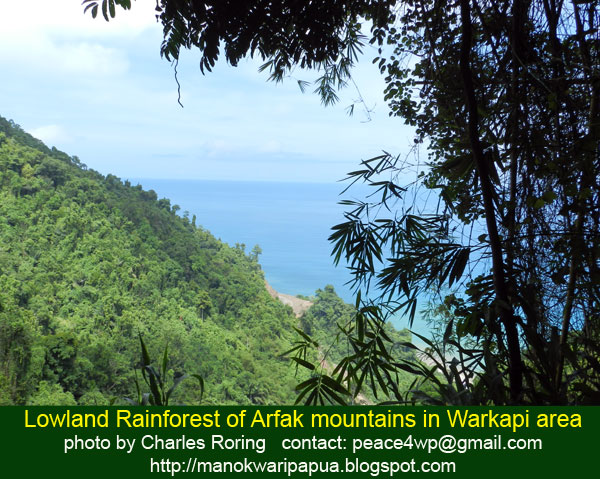
I saw the shrub when I accompanied 5 American visitors on a 4-day-3-night hiking tour in Arfak mountains. On the first day, we trekked the low elevation forest of Warkapi where we stayed there for one night at Camp Mawowi. The next day, we continued our trip to Kwau village by a 4WD car. We watch a tree kangaroo, bower bird and the magnificent birds of paradise. The trails to Camp Mawowi were very steep. Some portions of them were close to ninety degrees. Trekkers need to be extra careful when ascending and descending the steep slopes of this mountain range of Arfak. As a matter of fact, Arfak is one of the best destinations in the tropical region for trekking.
This trekking tour in Arfak mountains was part of an ecotourism tour packages that I have been promoting for nearly three years. The goal of this program is to preserve the rainforest and to provide employment opportunities to the local people.
After spending 4 days trekking in Arfak mountains of Manokwari, these American trekkers would continue their trips by Komodo liveaboard to Dore and Cendrawasih bays. by Charles Roring. To book a trekking tour in Arfak mountains, please, contact me via email: peace4wp@gmail.com

Wednesday, April 6, 2011

Trekking in Arfak mountains - a survey trip - part 1

I went to Warkapi village this morning. It is located at the foot of Arfak mountains, a popular trekking destination for travelers who want to see the nature and the wildlife of New Guinea island. Tropical rainforest in Arfak mountains in Manokwari regency has been a world-class trekking destination for those who have visited it. I left home at 7 a.m. to Wosi terminal. It is a bus station in Manokwari city where travelers can catch a bus to the village. I thought I was late for morning bus but as a matter of fact, I was the first passenger to arrive there. After finding a bus that was waiting for passengers who want to go to Warkapi, I got into the minibus (called taxi) and sat on the front seat next to the driver. Fifteen minutes later two women entered the taxi from the back door.
Another fifteen minutes had passed and the minibus was still empty. The women who were at the back bench now had left for another minibus that was going to Mupi village. Here I was alone waiting for some more passengers heading for Warkapi village.
I got bored waiting for thirty minutes in the Wosi terminal that was now becoming busier with people. I took my notebook out of my bag and began drawing things that I saw in a close distance around myself. The first object that I drew was a cart that belongs to an ice cream vendor. It was around five meters from me when I was drawing it. Later I could not continue drawing the details of the cart because the vendor pushed it away from me and put it in the middle of the rows of cars that were also waiting for passengers to several destinations outside Manokwari. I saw two children were buying some cones of ice cream from him. This is a traditional Indonesian ice cream. It is made of coconut milk called santan. The next object of my illustration was a Love doll.
It was a pink rabbit. Then I continued drawing another object which was a handle which passenger can hold when the bus goes on a bumpy road. It's shape like a "heart" or a love symbol.  I saw the handle in the car mirror that was located at bottom right corner of the window. the Finishing all these drawings, I found out that the car was still empty.
Suddenly the car driver of the empty bus told me that there was another car about to leave the terminal for Warkapi. He advised me to go with another minibus. It was a Mitsubishi L-300. I went into the car and sat on the back bench. We left for Warkapi at 8.51 a.m. It stopped for a while at a petrol station on Jalan Baru and then continued a one-hour trip to Warkapi. We arrived at 10.05 a.m. near a bridge. I got out of the car and met a man near the road side. I asked him whether he knew someone named Hans. Hans was in Warkapi to meet his uncle who was interested in developing his village as a starting point destination for foreign tourists who were interested in hiking or trekking in Arfak mountains. I had to walk for around 100 meters to find the house where Hans stayed. Finally I met him. Hans had a guesthouse in the territory of Kwau village far in the other part of Arfak mountains. He has received three groups of tourists coming from the Netherlands. His relatives in Warkapi want to make money from eco-tourism project that I am now promoting on the internet.
We talked for a while in his uncle's house and began surveying the nearby forest behind the village. We walked through the Warkapi river. Hans and his relative Hami said that we can see birds of paradise, tree kangaroo and other animals of Arfak mountains if we start trekking from this village. I conclude that the village can become the starting point for travelers who want to climb Arfak mountains but I need to make some discussions with his uncle first.
However, since there is no guesthouse in the village, tourists need to set up camps near the river if they want to start trekking in Arfak mountains. There are a lot of things that I need to do before the village can really become the recommended starting point for hiking and bird watching in Arfak mountains. The most important thing is how to inform or "educate" the local people about what the eco-tourism means, rainforest preservation and domestic wastes management. It is true that eco-tourism can provide alternative jobs to people living in and around the tropical rainforest of Arfak mountains but tourism and travel industry must not be considered as the only solution of the preservation of the forest and wildlife in Arfak mountains. Sustainable agriculture and fishing practices should be implemented in this village too.
There are some more stories that I still want to write about this small village and its people but I think I should save them for my later posts. Finally, I left the village at around 1.30 p.m. I now can  clearly  conclude that the blue Arfak mountains that I always see from far distance in Manokwari city are actually green in closer distance because they are richly covered with tropical trees where the mystery and beauty of Papua's wildlife are waiting to be discovered by us. If you are interested in trekking in Arfak mountains and need a guide to accompany you, please, contact me via my email: peace4wp@gmail.com. I will be happy to arrange the trip and become an interpreter for you while traveling in one of the most beautiful tropical mountains in the world. by Charles Roring
Also read: 
Hiking and Birdwatching in Arfak mountains Tour Package