Showing posts with label Table Mountain. Show all posts

Wednesday, December 8, 2010

Rainforest insects

Last November I and Monique (a volunteer from SDSP foundation) went hiking in the tropical rainforest of the Table Mountain near Manokwari city, the capital of West Papua province. We walked along the road that divides the jungle into two parts. Table Mountain with its forest is the closest natural environment that still exists in the city. The tropical rainforest that covers that mountain is rich of insects such as beetles, butterflies and wasps. Butterflies like to feed on nectars of rainforest flowers. During the morning walk with Monique, we could see various kinds of grasshoppers that like to eat young green leaves of plants and trees that grow in the forest. When the rainy season comes, trees and small vegetation grow faster. This creates competition between small plants and big trees. The presence of grasshopper can balance such competition by feeding on young leaves of the trees and plants that grow faster than others. In the food chain, insects such as the grasshopper are delicious food for lizards and soa-soa whereas these reptiles are prey to snakes and big birds.
When I write this post, I remember reading a book entitled the Malay Archipelago by Alfred Russel Wallace. In a chapter about the Netherlands New Guinea, he said that this Table Mountain is rich of insects. Yes, I can confirm his report here that there are still a lot of species of insects in this tropical rainforest.
European researchers have visited the Table Mountain of Manokwari since two centuries ago. One of them was Prince Leopold and Princess Astrid from Belgium in 1929. Prince Leopold collected a lot of animals, including insects in Manokwari. His collections can still be seen in ISNB Brussels.
I write this post to promote ecotourism and attract tourists from around the world to visit this forest. If you are interested in watching beetles, butterflies, and various other insects in this tropical rainforest, you can contact me via my email: peace4wp@gmail.com. I will be happy to arrange your trip around Manokwari and guide you to see the beauty of Papua's nature. by Charles Roring

Also read:

Thursday, September 9, 2010

Watching Beetles in the Tropical Rainforest of Manokwari

Every time I go to the Table Mountain, I will always find new and interesting things. They can be birds, plants, mushroom, flowers and etc. One of them is the wonderful world of insects. Along the asphalt paved road that divides the forest, we can see various butterfly, beetle, grasshopper, weevil and crickets. I am not an entomologist or insect expert so I cannot identify the species name of all the insects that I see in the jungle. One day, I walked with two tourists from Belgium. They were Wim and Vicky Boyden. We did some bird watching and Vicky managed to shoot some photographs of hornbills eating the nutmeg fruits in the tropical rainforest. It was morning time and we decided to continue our walk deeper into the pathway that led us to a large cave at the north of the Table Mountain.
At around 500 meters from the cave, we saw two insects. They were mating. I think they were beetles. Because their colour was dark brown, similar to the tree bark where they were attached to, I didn't see them. Vicky shouted, "Hey, look at this!" I stopped and turned to see what she had been trying to show. I moved closer and saw the two beautiful beetles that were mating. I took out my digital camera. It was a Sony Cybershot and shoot them. I didn't aware that there were beetles on my right side when I passed by a small tree whose trunk had been broken.
One month before that I was also hiking through the forest of the Table Mountain with Rhett Butler. He was looking for a beetle named eupholus magnificus. He had sent me an email about his intention but I was not sure if we could find it in the tropical rainforest of this small flat mountain. It was nearly dark when we decided to leave the forest and walked back to my Losmen Kagum. Rhett Butler, the founder of mongabay.com - the website that promotes efforts and policies on rainforest preservation said that if he was not able to find the beetle in this mountain, he would go to Biak. When we were about to reach the asphalt road, suddenly Rhett shouted, "Hey, look at this!" I stopped and looked back. There it was, the eupholus magnificus a very exotic beetle, the living jewel of the tropical rainforest of the New Guinea island. Rhett was very happy to see it. He took it with him back to the Losmen Kagum. After taking some pictures of it, he and I walked by to the foot of the Table Mountain to return it to its original habitat.
Besides taking pictures of these wonderful insects, I shot some nice flowers that I saw along the way to the cave. There are a lot of species of flowers in the forest. Their colors can be yellow, red, white, blue, purple and various other combination of colors which you can mention. These flowers provide nectar both to the insects and birds that will usually come in the morning.
The tropical rainforest in West Papua is an important ecosystem in the world. Its high biodiversity should be protected and preserved for future human generations and for the whole ecosystem of the rainforest itself. With more tourists coming to Manokwari, I hope that we can help the Papuan indigenous people earn some reasonable income the the goods and services that they provide so that they will not give up their land and forest to greedy investors who are only interested in eliminating thousand years old tropical rainforest with their 35 year old palm oil plantation that gives little or no benefit to the Papuan people. by Charles Roring
Also read:
Night Walk in the Tropical Rainforest
Tropical rainforest of Arfak mountains
Tropical rainforest preservation

Saturday, September 4, 2010

Sulphur-Crested Cockatoo from the Table Mountain of Manokwari

I, Rhett Butler - the founder of mongabay.com and Nico Nauw went to the Table Mountain of Manokwari on 2 August 2010. We did some bird watching and insect watching. Although this mountain was very closed to the city and was frequently visited by hunters, we were able to see sulphur-crested cockatoo (Cacatua Galerita), hornbills and other species of birds. Rhett brought his long lens camera so he could easily shoot the white cockatoo that was playing with his friends on the branches of a tall tree. It was still morning time when we heard the sound of cockatoo breaking the quiet atmosphere of the tropical rainforest. Carefully Rhett walked toward the source of the sound trying to find where the bird was in the canopy of the forest.
Sulphur-crested Cockatoo
I, and Nico Nauw - my friend who was now working as field or forest guide, decided not to make much noise in order not to attract the attention of the birds above us. I was a little bit doubtful whether Rhett could get a clear photograph of the sulphur-crested cockatoo. Why? Because we were on the eastern side of the forest that morning and the cockatoo birds were shouting from trees that were also located on the east of us. He had to face the sun ray which was not good for photography. Finally, Rhett shot his camera to the birds. He didn't show the result instantly. Two or three weeks after he had returned to the USA, Rhett sent me two folders of photographs that he took from Manokwari (the Table Mountain and the Arfak Mountains).   
Cockatoo birds are very sensitive to the existence of human beings at their surrounding area. Once they know that there is human down there, they will fly away. So, when you go to Manokwari for bird watching, don't be hurry to see the birds when you hear their screaming sounds in the trees. Try to walk slowly and keep hiding under the leaves and twigs of the understory vegetation. You only need to spot them and aim your camera at them and shoot. 
Also read:
  • Watching Hornbill and Caving in the Table Mountain
  • Caving in the Table Mountain
  • Hiking and Bird Watching in the Table Mountain

Friday, August 13, 2010

Watching Hornbill and Caving in the Table Mountain of Manokwari West Papua

The tropical rainforest of Table Mountain in Manokwari of West Papua is rich in vegetation and birds. It plays an important part in preventing land erotion and in supplying drinking water to citizens in the capital of West Papua province. Yesterday (13 August 2010), I went with Wim and Vicky Boyden to the Table Mountain to watch hornbills eating nutmeg, a kind of tropical fruit that is an important spice commodity. While we were walking along the road that devides the forest, we saw around twenty hornbill birds eating the nutmeg fruits. The fruits are smaller than the usual nutmeg fruits sold by farmers. Perhaps these nutmegs were from different species. With her long lens dslr camera, Vicky was able to shoot some pictures of this magnificent birds.
Blyth's hornbill in nutmeg tree.
Papuan Blyth's Hornbill (Rhyticeros plicatus)
After watching the birds, we continued walking deeper into the forest to do some caving. One hour later, we arrived at the mouth of the cave. There are around 6 caves in the Table Mountain but only three caves that are frequently visited. The cave that we explored yesterday was the biggest and the most popular. It was not difficult to enter and the floor of the cave was flat. 
Belgian tourists in Manokwari
Caving in Table Mountain of Manokwari
This morning, I am going with them to Senopi village to see male birds of paradise dancing in trees to attract their female birds the Kebar valley of the interior region of Tambrauw Mountains. I will write a special blog post about my tour into Kebar valley after returning from the area on 18 of August 2010. by Charles Roring

Also read: 

Saturday, August 7, 2010

Night Walk in the Tropical Rainforest of the Table Mountain

by Charles Roring
I and Rhett Butler - the founder of mongabay.com had decided to do night walk in the Table Mountain of Manokwari before he left this town for Jakarta the next morning. Accompanied by Nico Nauw, we hiked into the tropical rainforest of the Table Mountain again to see hornbills and insects. During the afternoon walk, Rhett managed to take some pictures of Sulphur-crested Cockatoo (Cacatua galerita- Latin). I was not a birder so I could not mention the English or latin names of all the birds in this forest. The tropical rainforest of the Table Mountain was a protected forest owned by the local government of Manokwari regency. We started climbing the forest at 4.30 p.m. on the 1 of August 2010. 
Red weevil

Tropical rainforest in this mountain has been categorized by Indonesian department of forestry as Taman Wisata Alam (TWA) meaning literally the Natural Tourism Park. We walked into the woods where Rhett photographed hornbills eating fruits of ficus tree, ficus benjamina (pohon beringin). When we arrived under the tree, the birds had finished eating and silently rested on the branches of the tree. Hearing the cracking sounds of the breaking dry twigs on the ground that we stepped on, the hornbill birds flew in a rush to another benjamin fig tree some 200 hundred meters away from us. We decided not to chase them and began concentrating on taking pictures of insects along the paved road that passed through the rainforest.
When the sun had set in the west, and when the canopy of the forest left abandoned in the dark,  with the help of two LED flashlights, we could see various colorful insects on the leaves of green vegetation on both sides of the road. I did not know whether they were nocturnal insects or not. But they had wonderful colors. There were grasshopper, crickets, and flies. I also saw lizards, snails and frogs. With my Sony cybershot pocket camera, I tried to take pictures of some insects that look red.  I was not really sure whether the insects which are presented in this blog post were grasshopper or cricket.
It was a fascinating experience walking in the dark forest and taking photographs of various tiny creatures that part of rainforest ecosystem. I was sad to see that this green forest of the Table Mountain of Manokwari has now been used as dumping ground for city wastes and garbage. I hope that the city dwellers of Manokwari would stop dumping their domestic and store garbage into this wonderful forest.
Tropical rainforest in the Table Mountain of Manokwari city plays an important role in absorbing the CO2 gases emitted by the city dwellers as well as storing large amount of water that is consumed the citizens every day. The existence of the forest also cools down the temperature of the surrounding area near the forest. With my current focus is now promoting eco-tourism for helping the local Papuans get more benefits from their natural environment without destroying it, the rainforest near this city will always within the range of my everyday attention.
Also read:

Monday, May 31, 2010

Beach and forest clean up campaign in Manokwari Papua

Eco-tourism in Manokwari city is a campaign that I am doing right now. I was born and grew up in this city which was only a very small town thirty years ago. Manokwari bay was beautiful. Of course it is still beautiful right now. Three islands in the Dorey bay are still surrounded by coral reefs. Most of them are now facing destruction from irresponsible fishing practices and run off of garbage thrown out to the sea by the city dwellers.
Every time I bring tourists to Mansinam island or Raimuti island, I always tell the local villagers not to throw their domestic wastes to the sea. It is better for them to dig a hole next to their houses where they can bury organic wastes. A fisherman in Arfai whose boat we rent said that he has begun informing the people living a long the beach of Arfai not to throw garbage to the sea. The Papuan who live there are happy to see western tourists swimming and snorkeling in the island.

I also promote forest clean up campaign in the tropical rainforest of the Table Mountain of Manokwari. Well, I once met some of the university students whose dormitory is located near the forest one month ago. I told them that I often bring foreign tourists to Table Mountain for bird and butterfly watching. Usually after traveling around the forest, we visit the Japanese war memorial monument to take a break there. While taking a rest, I and Paul, a friend of mine, pick up plastic garbage scattered around the monument. The students like the idea. The next time I visited the monument again, I saw the garbage had been burnt, perhaps, by the student. Actually I don't like the idea of burning plastic but there is no processing plant in this city which can recycle such waste. So, burning is considered the easiest solution to clean up the area.
With more tourists come to Manokwari, I am very optimistic that the citizens in this city will be aware about how important the marine environment and tropical rainforest are not only for foreign tourists but  also most importantly for our own life.
There are a lot of things that we need to do to clean up the Dorey bay of Manokwari from plastics and the presence of tourists in this city will attract the attention of both the citizens and the government to be good hosts for them. Clean environment is the keyword that we need to introduce to every ear of the city dwellers in order to preserve Manokwari's nature. by Charles Roring

Saturday, May 29, 2010

Watching Butterfly in the Table Mountain of Manokwari of West Papua

I, Katja and Paul went to Table Mountain on 26 May 2010. Because we wanted to watch butterfly, we woke up early. At around 6 a.m we were on top of the mountain hiking along the road. The air was fresh and the view of Manokwari city looked calm. When the sun light hit the surface of the green leaves and the flowers, various colors of ornamental butterflies came out of their hiding places and began flying around. It was wonderful to see a lot of butterflies.  One even landed on the tip of my shorts. We did not need binoculars to watch them. Butterfly watching in Manokwari's Table Mountain is my favorite activity. Butterflies were just everywhere, big and small, black, white, yellow, and brown.
We walked to Japanese war memorial. It has a little open area provided by local government to Japanese government to build a monument for honoring the Japanese soldiers who died during the the Pacific War. There, I and Paul picked up some garbage scattered around the monument which had been thrown by people who visited place. That's what we usually do to keep the surroundings of the monument clean. Katja (the German tourist) also helped us. We put all the wastes at the left side of the gate and Paul burnt them.
 We took a rest for around 30 minutes there before continuing our trip to see more butterflies and other unique vegetation of tropical rainforest. Because Table Mountain is located near the Manokwari city and not too high from the sea surface, we can see a lot of insects and birds in it.
 As we were descending the mountain Kompleks Missi where my house was, Katja stopped for a while and picked up a large dry leaf of Sukun tree (bread tree). She asked me to take a picture of her standing with the leaf. She said that in Europe, there are no leaves with such size. She was amazed by the leave. In the tropical rainforest of Papua, we can see a lot of unique plants that always attract tourists' attention.
The best time for bird watching and butterfly watching is from 6 a.m and 11 a.m. We can actually do it all day but I think morning and before sunset are the best times for admiring and appreciating the nature. If you are interested in hiking in the Table Mountain of Manokwari, you can contact me - Charles Roring - by email to: peace4wp@gmail.com
Also read: A Visit to Mansinam Island and A Meeting with Peter Rumbruren

Tuesday, May 18, 2010

Herbs to cure Malaria from Manokwari Rainforest

Several months ago (January, 2010), I accompanied three Russian tourists hiking in the Table Mountain of Manokwari. While we were walking we saw a plant whose vine hanging on a large tree. My friend, a local Papuan named Paul, called it "Tali Kuning" or "Yellow Rope." 
Tali Kuning is used to cure Malaria, a deadly disease which is common in West Papua and other tropical regions. When the Russians asked him how to use it, Paul explained that the Papuan usually boils the tali kuning as if they are boiling tea. The one who suffers Malaria needs to drink a glass of tali kuning tea three times a day for at least one week. Its taste is very bitter. It is considered as a very good herbal medicine for curing Malaria. by Charles Roring

Tuesday, May 4, 2010

Butterfly Watching in Manokwari's Table Mountain

This afternoon I and my friend Paul went to the Table Mountain of Manokwari. We walked through this tropical rainforest of West Papua to see butterflies and other animals that we might see in the jungle. I brought my digital camera, Sony Cybershot DSC W30. Butterfly watching or butterflying could be done in the mornings at around 8 to 10 or in the afternoon before sunset.
Personally, I don't know the names of the butterflies, but I was amazed to see the photographs of the butterflies and the worms that I took during that afternoon's nature walk
There were butterflies that attach their bodies under the leaves of the plants and there were those that attach their bodies on the green leaves of the tropical vegetation. They looked beautiful. There were also big size butterflies such as Swallowtail Blue Mountain (Papilio ulysses) or the Birdwing Butterfly Ornitopthera priamus, The Silkh Owl (Taenaris catops) and Cruiser Butterfly (Vindula arsinoe). Unfortunately, I was not able to take pictures of them.
If you are a butterfly enthusiast and are interested in visiting Manokwari for watching the butterflies in the Table Mountain and other places in this region, please contact me - Charles Roring through my email peace4wp@gmail.com. I will be happy to be your travel guide in this city.
There are several places in West Papua that are good for watching butterflies in their natural habitats. The ones that I have seen while guiding
Butterfly and Flower Art Merchandise:
Please, support our efforts in promoting the protection of tropical rainforest and coral reef environments by ordering the following products.  The money that we get from selling the merchandise will be allocated for the campaign works on the preservation of jungle and marine environment.


Wednesday, March 31, 2010

Caving in the Table Mountain with Grietje

Last Saturday, I accompanied Grietje and Ani to Table Mountain. Actually Shanti and Dorthea, volunteers from YAT, also came with Grietje and Ani. But Shanti gave up at the beginning of the hiking so, Dorthea had to go back to YAT before climbing the steep hill leading to the flat top of the mountain  that is covered with big trees of tropical rainforest. I, Nico, Grietje, Ani decided to continue hiking and caving in the Table Mountain. We started our trip in the morning from Xavier bookstore. Besides hiking, we did some caving. It was a challenging experience because at that time Manokwari was in the rainy season. We went to a cave in the north of the Table Mountain, the largest cave where small and large bats live side by side. The  ground of the cave was sticky due to the mud that had been formed for several days during a-one- week rain before we arrived. When I was taking pictures of the flying bats, one of the big bats flew towards me. I thought it was going to hit me but suddenly it turned back and only flying in circle.


I used my digital camera Sony Cyber-shot DSC-W30 to shoot the following photographs. I was not so sure whether the results would be good or not as the interior of the cave was very dark. I set the dial mode to P because based on my previous experience the photo quality was better than the automatic and ISO settings. After they had been optimized in Adobe Photoshop CS3 where I reduced the file size and added some explanation at the bottom of each photographs, I uploaded them to this post. I am satisfied with the result because the images are quite bright.
There are several caves in the Table Mountain of Manokwari. If you are interested in caving, you can contact me. Don't forget to bring boots, apply mosquito repellent lotion, and binoculars (for bird watching). You might also need a hat and a rain-jacket if you go to Manokwari during the rainy season. If you are already in Manokwari, you can call me 081332245180. by Charles Roring

Also read:

  • Cave exploration inside tropical rainforest of Manokwari 
  • Photographing bat in a cave 

Thursday, March 11, 2010

Go Hiking in the Table Mountain

Experience the beauty of tropical rainforest - Situated in the north of Manokwari, Table Mountain has been a good recreational place for city dwellers and tourists who love to go hiking and see the nature of Papuan tropical rainforest.  Hiking is the best way to discover the secret beauty of the “green jewel” of the equator.
My trip to the Gunung Meja starts in the morning from Losmen KAGUM, a small hostel located at the foot of the Table Mountain. Usually, I and some tourists leave for the Table Mountain at 9 a.m.
We will walk along the road that goes to SD Negeri 1 elementary school (formerly known as Klim en Daal during the Dutch period) before entering pathway leading to the Top of Table Mountain.
As we ascend the slope of the mountain, we will see Jati and Eucalyptus Deglupta trees which were planted by the Dutch. Entering the tip of the forest, we will begin to feel a sudden change in air temperature. Under the canopy of the tropical trees, it is cool and fresh. Various kinds of palm trees and other vegetations thrive healthily.
For energetic travelers, the pathway leading to the top of the Table Mountain is a good warming-up trail that stimulates their body to enable them breath more clean air that is good for their health.
The singing of birds and the sound of insects is the best natural music that brings peace and calm in the mind of every nature lovers.
The Table Mountain of Manokwari in West Papua which shelters the primary forest in the middle of the city is a protected botanical park which also serves to educate every body on the variety and abundance of Papuan flora and fauna.

Mushroom
The ground condition of the tropical rainforest of the Table Mountain is wet, humid and full of moisture. It is an ideal growing place for mushroom. During the rainy season, we can find a lot of  species of mushrooms emerging from the top soil, decaying leaves and woods. They are rich of organic nutrients that mushrooms need to sustain their growth. Although mushroom can be found all year round in this forest, the best time to see the mushroom in Papua is during the rainy season which usually begins from December and ends around May. Don’t forget to bring your raincoat if you want to explore the beauty of these soft plants during those months.
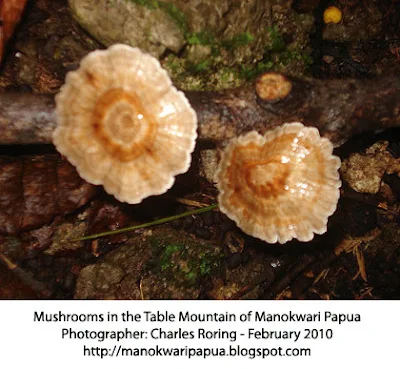
 Under the giant trees, the ground receives very little sunlight, mushrooms bloom like other ordinary flowers early in the morning. Some of them even have forms that are similar to coral reef. Green grass and other vegetations cover the ground surface of the Table Mountain keeping the ideal humidity for the mushrooms. Some of them are edible, some have medicinal functions. Most of the edible tropical mushrooms do not have pungent taste as the European truffle do. But they are high in fiber and contain vitamins that are good for our health. If you are interested in eating mushrooms in Manokwari, I advise that you buy them at traditional markets in Sanggeng and Wosi areas of the city. The indigenous Papuan know the ones that are edible and the ones that are not.
Although the Table Mountain is located near the Manokwari city, it is still rich of green plants, thanks to the tougher stand from the local government in keeping it as a protected forest. When we walk at night, we will find some macro and micro fungi that glow in the dark.
The deeper we walk into the jungle, the more we discover its beauty. The Table Mountain of Manokwari has several natural caves which are homes to unique lizards, and night animals such as bats. These animals sleep during the days hanging on the crystal walls of the caves and flying out to find food at nights.

Exploring the Caves
Escorted by our experienced forest guides, we will be able to see these exotic animals and take some pictures of their dwelling places.  Make sure to bring torch to help you navigate inside the caves.
As we walk deeper into the cave, we have to keep silent to let the bats sleep soundly and peacefully. Take the pictures of the animals from safe distance and use the zoom feature of your digital photo or video camera to have a closer look of the bats. If you approach too close to them, bats will be afraid and fly away.
To have better quality photographs or video recordings, check your camera whether it has been set for night or dark shooting. If you don’t know how to set it on your equipment, read the manual book or ask someone who knows how to use such equipment.
The walls and the ground surface of the caves are wet, and slippery. Move slowly and carefully as you explore deeper into the interior of the cave. Respect the animals that live in the cave. Never catch the bats or the lizards as you are only a guest and they are the real host of the cave. 

Bird Watching
Bird watching is a favorite activity which tourists like to do when wandering inside the rainforest of Table Mountain. The perfect time to do bird watching is during sunny days, in the morning and in the afternoon.
The sounds of birds singing and dancing on the branches of the trees are beautiful natural music that is powerful in relieving our mind from workload stress which we usually experience in the city.
Birds usually gather at certain trees that are fruiting. Walk slowly and avoid being seen by them. Hornbill like to eat fruits in a group of six to ten, sometimes more. When flying the waving of their wings sounds like a tornado in a calm forest.
Blyth's Hornbill
 Use long-distant lenses in your digital photo camera to shoot birds at high trees. In the afternoon before the sunset, big birds such as palm or giant cockatoo will fly back to their nests which are holes in tall and big trees. Before resting in their nests they will sing and play with their friends for a while. This is the perfect time for bird watchers to see them. With the help of our experienced forest guides, bird lovers will be able to see various species of Papuan birds in the Table Mountain of Manokwari. Bird watching in the Table Mountain is a prelude for a more challenging adventure which many tourists can experience when they take hiking tours in Arfak Mountains located on the opposite site of the Dorey bay.

Insect Watching
When we walk through the tropical rainforest, we will see various insects from the ground up to the leaves of branches and twigs of trees.
Tourists from outside of Papua should apply mosquitoes repellent lotion on the skin of their hands, neck, and other open areas both in the body and legs.
Insects are an integrated component of tropical rainforest ecosystem. You might have watched on television that bees and butterflies play very important role in the pollination of plants. This also applies to  wild flowers in the forest. 
Spiders patiently build their net to catch other small insects flying around.
When doing insect watching, be careful not to be bitten by ants or be stung by bees. Insects are small and fragile, make sure that you will not hurt them.
If during an observation you see an insect is being threatened by its predators, please do not interfere as it is the natural occurrence that always happen everyday inside the rainforest.
What tourists must do is to minimize the impact of their presence inside the forest.
For observing small insects, you may need a loop to enlarge their visual appearance. Photographing small insects from closer distance needs special technique. If your digital camera has been set to auto-focus, you will be able to shoot pictures which will result in good quality photographs. But if you have known your device well, you can set it to macro view that is more suitable to shoot objects like small insects in closer distance.
Humidity is very high in tropical rainforest. Only around 5 percent of sunlight reaches the ground. This makes it an ideal place for insects to live. Butterflies, beetles, grasshoppers and mosquitoes, can easily be found among green vegetations in the Table Mountain of Manokwari. Collecting insects for research purposes in the tropical rainforest is not recommended except if you are a professional entomologist. This is written by Charles Roring