Dopi is the tributary of Pami - a river in the north coast of Manokwari. It is a nice destination for nature lovers who want to go hiking in the tropical rainforest of West Papua. Last week, I guided a British biologist, Georgie, on a 3-day hiking tour in the jungle of Dopi river. This British biologist was interested in tropical flowers such as rhododendron, dendrobium and terrestrial orchids. Some flower trees such as the African tulip (spathodea campanulata) grew at the bank of the river. They can easily be recognized by their cup shaped flowers whose petal colors are orange and yellow. The following is the photograph of a terrestrial orchid that we saw in the jungle. I guess it is from Genus Spathoglottis. It looks very similar to spathoglottis plicata but honestly I dare not identify its species name.
During our hiking tour, we were able to see various species of birds including the lesser birds of paradise (paradisaea minor), blyth's hornbill (rhyticeros plicatus) and pygmy parrots. I also took some pictures of pinon imperial pigeon that was perching on the branch of a tree around 20 meters above my head. The bird has got delicate gray feather. With my Nikon Coolpix P500, I shot the birds several times. I had to use 2 second self timer feature of the camera to create sharper photograph. In my first trip to this forest last year with Herman van der Hart and Elizabeth Pot, I was lucky because I saw a Western Crown Pigeon.
While walking through the Dopi river, I caught a green frog and handed it over to Georgie. She gently held this amphibian animal but later it jumped out of her hands and into the water again. I hardly ever saw a frog swimming in the river. Perhaps, it jumped into the river trying to escape from its predator (a snake). The coral rocks that we saw at the bottom of the river indicated that the land had been elevated from the sea perhaps since several centuries ago. Alfred Russel Wallace in his book The Malay Archipelago also explained about the elevated reefs not only in New Guinea but also in other islands such as Moluccas, Java and Timor.
We stayed in a camp that had been built for tourists. At night we ate stir fried vegetables and sweet potatoes. When we were busy preparing our dinner, Georgie took the opportunity by learning how to make sambal (chilli sauce).
This rainforest tour is offered to anybody who wants to explore the tropical rainforest of West Papua in affordable price. Besides hiking, birdwatching and camping, tourists will be able to appreciate the high biodiversity of the rainforest and support its preservation. The rainforest tour itself will provide employment opportunities to local people who are the main stakeholder of this precious environment. If you are interested in taking a rainforest tour in Manokwari, please, contact me via e-mail: peace4wp@gmail.com. by Charles Roring
Also read: Hiking tour in Inggramui forest
Wildlife Watching, Birding and Photography Tours in Sorong city, Malagufuk of Klasouw valley of Sorong regency, Klabili and Sausapor in Tambrauw, Waigeo and Batanta in Raja Ampat of West Papua as well as Sonder, Tomohon, Mount Mahawu, Manado, Bunaken National Park, Tangkoko Nature Reserve in North Sulawesi. Please, contact me (Charles Roring) by e-mail to: peace4wp@gmail.com or by whatsapp to: +6281332245180
Pages
- Adventurous Wildlife Trip to Batanta island of Raja Ampat
- About Me/ How to Contact Me
- Wildlife Watching in Klalik Village of Sorong Regency
- Birding in Arfak Mountains
- Birding in West Papua - A Trip Report
- Explore Sorong City and Its Surroundings
- Short Birding Tour in Sorong City
- Birding at the Outskirts of Sorong City
- Sorong City Sightseeing and Birdwatching Tour
- Nature Tour Near Sorong City
- Jungle Tour Near Sorong City
- Birding in Raja Ampat Islands
- Raja Ampat Snorkeling Tour
- Birding Tour Across Tangkoko Nature Reserve, Mount Mahawu, Sonder Forest and Manado City
- Birding at the Outskirts of Manado City
- Birdwatching Tour in Sonder of North Sulawesi, Indonesia
- Birding and Photo Tour in North Sulawesi: From Coastal Forests of Tangkoko to Highland Trails of Sonder
- Birds in North Sulawesi
- Manado City Nature Tour: Birdwatching, Butterfly watching, and Sightseeing
Thursday, May 31, 2012
Tuesday, May 29, 2012
Rainforest Flower near Dopi river
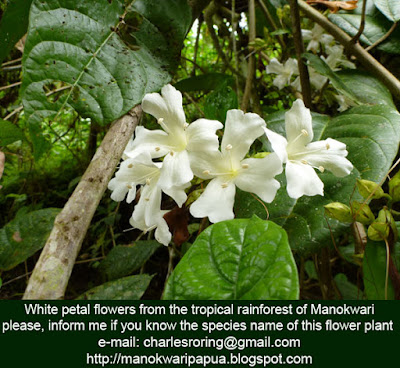
While hiking with Georgie - a British biologist through a tropical rainforest near Dopi river, I saw various species of flowers that I could not identify. One of them is shown on the following photograph. This flower plant was located in a tall tree. I think it was an epiphyte. I forgot to ask her to write its name on my book so that I could mention it on this post. So, if you know its English or Latin name, please, inform me.
This flower plant was around 25 meters above hour head. I used my telephoto lens bridge camera Nikon Coolpix P500 to shoot it. The next morning, guided by Elia Kambu, I and Georgie walked up some slopes to a place where we could see some terrestrial orchids that grow along an old logging road of the rainforest of Inggramui village. If you are interested in hiking in the tropical rainforest of Manokwari, you need to bring sleeping bags, mosquito net, GPS device, compass, and the most important thing is a bottle of insect repellent lotion. by Charles Roring
Friday, May 18, 2012
Georgie Tries Chewing Betel Nut
I accompanied Georgie - a British tourist on a little tour around Missi and Anggrem areas of Manokwari to visit some Papuan artists. She bought bracelets, earrings, necklaces and wooden statues as gifts for her friends and relatives.
When we were in Anggrem, Georgie saw some Papuans who were sitting near a table where betel nut and betel pepper were being sold to pedestrians. She told me that she would like to try chewing them. We stopped at the table and asked the vendor how much a package of pinang was. Pinang is the local name for betel nut + betel pepper + lime powder. The man who stood near the pinang table said that one package was Rp. 3,000.
She paid 5,000 and got 2,000 as the change. The man took some pinang and began chewing it to demonstrate how it should be chewed. First, he peeled off the husk of the betel nut with his front teeth. There was still some husk fiber covering the seed when he began chewing it. After a few seconds, he took the betel pepper and started to chew it. Then he dipped the pepper on the lime powder and put it into his mouth.
Georgie followed him. It was a little bit difficult for her to peel the green husk of the pinang from its seed. Women who were watching her said that if she chews pinang regularly her teeth will become stronger and her mouth will be fragrant. It won't be smelly when she wakes up in the morning.
After around 2 or 3 minutes, she could make it and began chewing the unripe pinang. She took the betel pepper and acted as what the Papuan man had done. Five minutes later, I could see that Georgie's face turned red. Sweats coming out of her face and neck. The juices of these herbs reacted fast. She spat on the ground and there the juice had turned red. I thought she was drunk or was feeling dizzy. I asked a glass of water from women who were sitting near us. One of them entered the kitchen and came out with the water. Georgie gargled to rinse her mouth and spat it to the ground. She drank the water. She felt better after that. A girl handed a baby to Georgie.
While he was in her hands, I took the opportunity to make picture of them. It was a nice experience for her chewing the betel nut for the first time although she was not familiar with its taste. by Charles Roring
When we were in Anggrem, Georgie saw some Papuans who were sitting near a table where betel nut and betel pepper were being sold to pedestrians. She told me that she would like to try chewing them. We stopped at the table and asked the vendor how much a package of pinang was. Pinang is the local name for betel nut + betel pepper + lime powder. The man who stood near the pinang table said that one package was Rp. 3,000.
She paid 5,000 and got 2,000 as the change. The man took some pinang and began chewing it to demonstrate how it should be chewed. First, he peeled off the husk of the betel nut with his front teeth. There was still some husk fiber covering the seed when he began chewing it. After a few seconds, he took the betel pepper and started to chew it. Then he dipped the pepper on the lime powder and put it into his mouth.
Georgie followed him. It was a little bit difficult for her to peel the green husk of the pinang from its seed. Women who were watching her said that if she chews pinang regularly her teeth will become stronger and her mouth will be fragrant. It won't be smelly when she wakes up in the morning.
After around 2 or 3 minutes, she could make it and began chewing the unripe pinang. She took the betel pepper and acted as what the Papuan man had done. Five minutes later, I could see that Georgie's face turned red. Sweats coming out of her face and neck. The juices of these herbs reacted fast. She spat on the ground and there the juice had turned red. I thought she was drunk or was feeling dizzy. I asked a glass of water from women who were sitting near us. One of them entered the kitchen and came out with the water. Georgie gargled to rinse her mouth and spat it to the ground. She drank the water. She felt better after that. A girl handed a baby to Georgie.
While he was in her hands, I took the opportunity to make picture of them. It was a nice experience for her chewing the betel nut for the first time although she was not familiar with its taste. by Charles Roring
Tuesday, May 15, 2012
Rhododendron Flowers in the Rainforest of Arfak
Arfak mountains have been famous as tour destination for visitors who want to go hiking and birdwatching. As a matter of fact, its rainforest is the natural habitat of rhododendron flower plants. The following photograph shows (perhaps) a species of rhododendron zoelleri that is growing near the guesthouse of Syioubri village.
If you are interested in taking a rainforest tour in Arfak mountains to see the flowers or to watch birds of paradise that live there, please, contact me via my email: peace4wp@gmail.com
Sunday, May 13, 2012
Rainforest Flower Ipomoea Aquatica
The following flower in Latin is called Ipomoea Aquatica. This is a famous aquatic plant in the tropical regions. In Indonesia this plant is known as "kangkung." People eat both the stem and the leaves of kangkung as delicious vegetables. The kangkung vegetables can be served in raw or stir-fried with salt, onion and dried shrimp paste added to the dish. Although Ipomoea Aquatica has got beautiful flowers, they are not used in indoor decoration. In tropical rainforest, this plant grows in swamps or in the river with slow moving stream.
This rainforest flower has got several English names. Some of them are water spinach, water morning glory and water convolvulus. The stems of Ipomoea Aquatica are hollow enabling the plant to float on the water. I took the picture of these white flowers of the water spinach next to my parent's house in Amban area of Manokwari.
Last week I was able to identify another white flower which I saw growing in Inggramui forest. Its name is Glory Vine (Faradaya Splendida). This vine flower releases very nice fragrant.
The biodiversity in the tropical rainforest of Manokwari is very high. That's why the rainforest is seen as a recommended hiking destination for tourists who want to see the beauty of nature of New Guinea. If you are interested in hiking in Manokwari, please, contact me via email: charlesroring@gmail.com
Also read: Rainforest Flowers in Inggramui
Subscribe to:
Posts (Atom)